








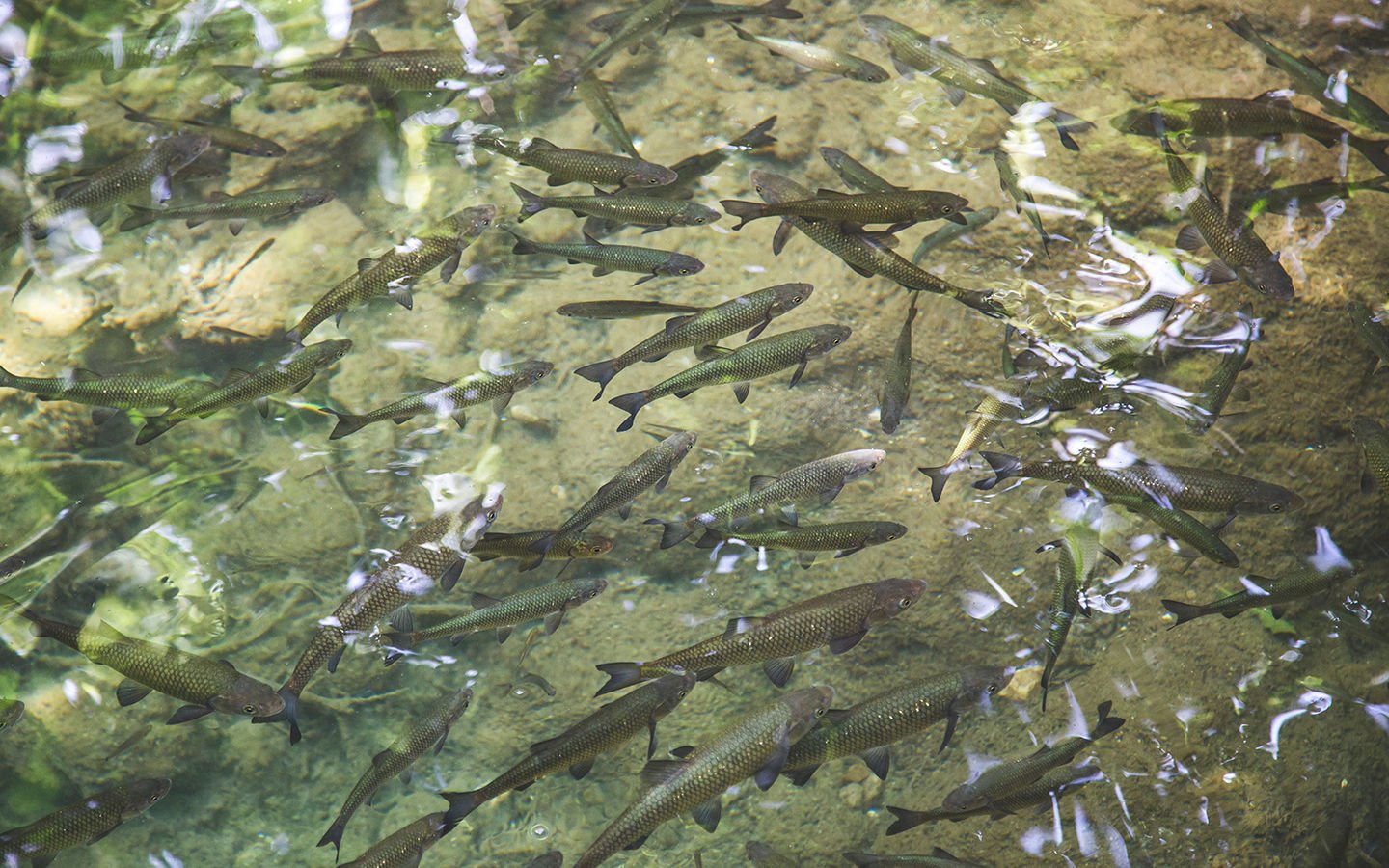
Worldwide demand for seafood has increased by nearly 50 times since the 1950’s and continues to grow. With approximately three-quarters of the world’s fisheries fully exploited or depleted, the dependence on farm-grown seafood has steadily increased. In fact, for the first time this year, more fish consumed in the world will be farmed rather than caught in the wild. The vast majority of salmon and shrimp consumed in the U.S., for example, is sourced from fish farms in Asia.
To meet predicted demand for seafood by 2020, aquaculture will have to double production. Yet fish farming has a poor environmental reputation–excess feed and copious waste cause water pollution, farmed fish escape into the wild and spread disease, the fish meal needed to feed them depletes marine systems. These problems occur in part because fish farms are monoculture operations which are placed within complex marine ecosystems. In nature, ecosystems are interdependent, with each species contributing to the benefit of other species up and down the food chain, minimizing waste and pollution.
Dr. Thierry B.R. Chopin, a professor of marine biology at the University of New Brunswick, and Shawn Robinson, a St. Andrews Biological Station scientist and adjunct professor at UNB Saint John, have drawn on the basic tenets of biodiversity and interdependence, and developed a new model that can make fish farming more environmentally friendly. They raise several species of sea life–for example, Atlantic salmon, mussels and different seaweeds–together in the same water. These species complement one another ecologically. The seaweeds and mussels use some of the by-products from the fish and extra food to help grow. Waste from one aquatic species becomes food for another, and the seaweed cleanses the water of surplus nitrogen. By mimicking the ocean’s biodiversity, waste is reduced while each species benefits. The name for this process is Integrated Multi-Trophic Aquaculture, or IMTA.
Besides reducing the environmental impact of marine based aquaculture operations, IMTA has the additional benefit of creating multiple revenue streams for the fish farmer. Mussels and kelp which remove excess nutrients from the salmon operation are also marketable crops.
The economists on the IMTA team have calculated that, over 10 years, salmon aquaculture operations can make more money with IMTA than with monoculture operations.
“It’s diversification. Don’t put all your salmon eggs in the same basket,” Thierry said. “It’s true in agriculture. It’s also true in aquaculture.” A company called Cooke Aquaculture, in partnership with the University of New Brunswick and the Department of Fisheries and Oceans, is now practicing this approach at a half dozen fish farms in the Bay of Fundy, and it wants to expand to another 11 sites.
“To continue to supply the demand, aquaculture needs to continue to grow,” says Thierry. “But it must develop innovative, responsible, sustainable and profitable practices.”
The research partnership’s work has been recognized by the Natural Science and Engineering Research Council of Canada, which recently awarded the project with a Synergy Award for Innovation.