




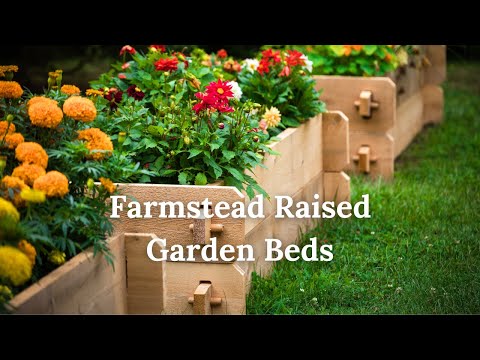


Farmstead Stackable Cedar Raised Garden Bed
Farmstead Stackable Cedar Raised Garden Bed
 Free Shipping
- Satisfaction Guarantee

Summary
Summary
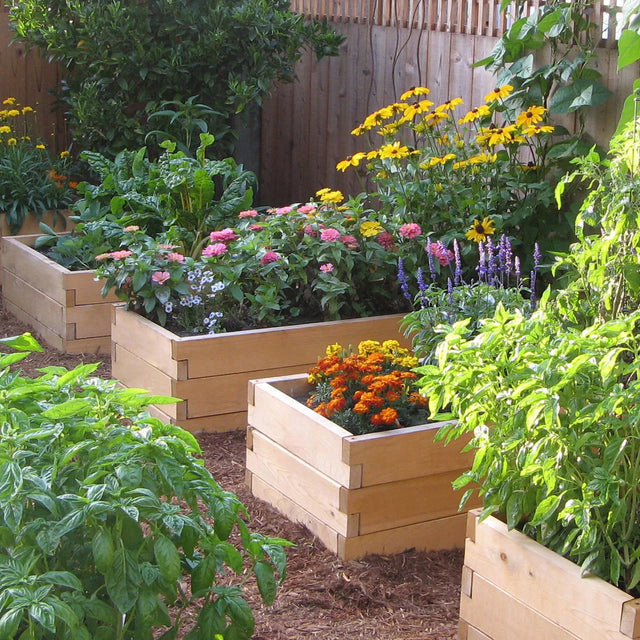
Each kit includes one 8" tall raised garden bed. For deeper planting, stack two kits to create a 16" tall bed or three kits to create a 24" tall bed.
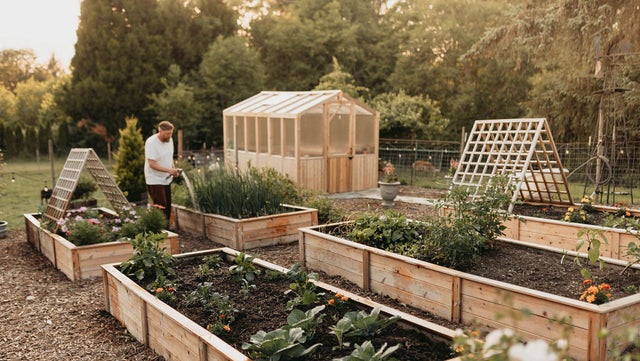
An elegant age-old design for raised garden beds. Farmstead Raised Garden Beds are easy to assemble and handcrafted of Vermont White Cedar, which lasts many years and weathers to a soft silver grey.
A stackable cedar raised garden bed you build in minutes, with no tools. Each kit gives you 8 inches of planting depth. Stack two kits for 16 inches, three for 24 inches, four for 32 inches - a working height that lets you garden standing up. Handcrafted in Vermont from untreated white cedar, in 14 sizes from 2 ft x 3 ft up to 4 ft x 8 ft.
Please see inside dimensions below. Sizes above are the outer dimensions of the box from the tips of the corners. For inside dimensions (planting area) subtract 3/4-foot from the width and the length.
Stack them higher and save your back
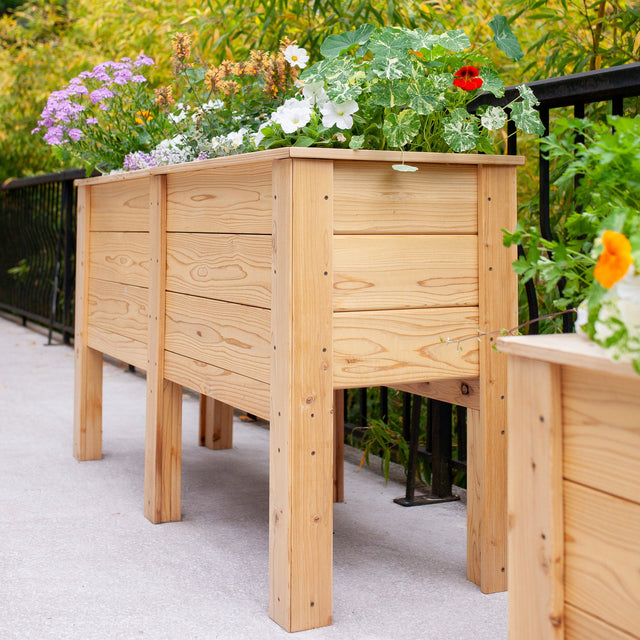
Most raised beds give you one depth and that is the end of it. This one is built to stack, so you choose your own depth and can change your mind later. One kit sits 8 inches above ground, enough for lettuce, herbs and greens. A second kit takes you to 16 inches, deep enough for almost any vegetable. A third gives 24 inches, a fourth 32, high enough to garden without kneeling.
Stacked beds need nothing to hold them together. The weight of the soil keeps them in place, and on level ground they will not shift. For extra security, bracket them together with inexpensive hardware from any local store.
Which Depth Should You Choose?
- 8 inches, one kit. Salad leaves, spinach, herbs and radishes. Lowest cost, quickest to fill with soil.
- 16 inches, two kits. The all-rounder: tomatoes, peppers, beans, carrots and most root vegetables, with far less bending.
- 24 inches, three kits. A deep root run for potatoes and parsnips, and comfortable to work sitting on the edge.
- 32 inches, four kits. A true standing-height garden, worth it if kneeling is difficult.
Strong and functional
Lumber is custom sawed to a thickness of 1¼ inches for greater strength and longer life. Cedar slot and peg raised garden beds cannot pull apart, as may happen with beds that are nailed or screwed together. This cedar is not sanded or treated, giving it an unfinished, rustic quality. The pegs are made of black locust wood, which is very rot resistant.
Sizes and Planting Area
Farmstead beds are measured from the tips of the corners, so the space you plant into is smaller than the size on the label. Planting area below is for a single kit; stacking changes the depth, not the footprint.
- 2’ x 4’ = 1¼ ft x 3¼ ft
- 2’ x 5’ = 1¼ ft x 4¼ ft
- 2’ x 6’ = 1¼ ft x 5¼ ft
- 2’ x 8’ = 1¼ ft x 7¼ ft
- 3’ x 3’ = 2¼ ft x 2¼ ft
- 3’ x 4’ = 2¼ ft x 3¼ ft
- 3’ x 5’ = 2¼ ft x 4¼ ft
- 3’ x 6’ = 2¼ ft x 5¼ ft
- 3’ x 8’ = 2¼ ft x 7¼ ft
- 4’ x 4’ = 3¼ ft x 3¼ ft
- 4’ x 5’ = 3¼ ft x 4¼ ft
- 4’ x 6’ = 3¼ ft x 5¼ ft
- 4’ x 8’ = 3¼ ft x 7¼ ft
Tool-Free Assembly
Watch our video below! It takes less than five minutes to assemble these cedar raised beds. No tools are required. Simply slip the end of one board through the slot of the other and secure with provided wooden pegs.
Raised beds can be placed directly on sod, lawn, or even a weedy patch. Once the bed is filled with soil, any weeds underneath will soon form a composted base. For best results, you may want to dig down a few inches to clear any large rocks.
No chemical wood preservatives
Unlike pressure treated lumber or railroad ties, the untreated Vermont White Cedar used in these raised garden beds is naturally rot resistant. There are no harmful chemicals that could leach into your soil and plants. If you want to treat wood naturally, we recommend Eco Wood Treatment – a non-toxic mineral-based formula safe for vegetable gardens.
Wood Dimensions: 1.25 inches thick by 8 inches wide.
Caring for Your Cedar Bed
Nothing needs to be done. Untreated Vermont white cedar is naturally rot resistant and weathers to a soft silver grey over the first season or two. That colour change is the wood settling in, not wearing out.
To keep the wood closer to its original tone, treat the boards before you fill the bed, while they are still light enough to lift. Eco Wood Treatment is a non-toxic mineral-based formula, safe on a bed you grow food in.
After that, keep the soil an inch or two below the top edge, and clear old plant material off in autumn.
FAQ
How much soil will I need?
Multiply the planting area from the sizes table by the depth in feet. One kit is 8 inches, two thirds of a foot, so a 3 ft x 6 ft bed needs roughly 8 cubic feet. Double that for 16 inches, triple it for 24. Or let our Soil Calculator do the sum.
Do the beds have a bottom?
No. The bed is open underneath and sits straight on the ground, so roots grow into the soil beneath. That is also why it can go on sod, lawn or a weedy patch.
Can I set it up directly on grass or lawn?
Yes - straight onto sod, lawn or even a weedy patch. Fill it with soil and whatever is underneath composts down on its own; just clear any large rocks first.
Is the wood treated? Is it safe for growing food?
It ships completely untreated - nothing on the boards but the cedar itself, so there is nothing to leach into your soil. Rot resistance comes from the wood, not from chemicals. If you want to hold the original color, use a finish that is safe for food gardens, such as Eco Wood Treatment.
For this bed you need about:
The numbers update when you change the size.
Work out the soil for this bed with our Soil Calculator.
Ships within 2-3 Business Days.
See our Shipping Details page for possible shipping methods and time in transit.
Please reach out to our customer service team with any questions prior to ordering.
We've Got People Talking
- Rated 5 out of 5 starsGreat bed!
I love these beds! They came so nicely and look so clean! They were easy to put together and they feel very sturdy. This is my first garden bed and I am so very excited for this and feel I made the right choice; they were exactly what I was looking for. I would highly recommend purchasing from eartheasy.
April C.Verified Buyer - Rated 5 out of 5 starsFor garlic
For garlic
WILLIAM L. - Rated 5 out of 5 starsMost beautiful raised beds on the market
I have ordered a number of these raised beds over the years. They are beautiful and last forever and even survived a tornado though I needed new peg which were happily provided. Most recently I ordered smaller ones to surround dwarf fruit trees. This completes the conversion of my backyard into full food production. Just beautiful. My grandson loves to pound the pegs in and is quite good at it now!
megan b. - Rated 5 out of 5 starsGood buy
Very well made and easy to put together
Not worth the effort to go out but the wood and then do all yourself
Delivery was just within a couple of days
cornelia h. - Rated 5 out of 5 starsEasy and simple to assemble
I have assembled different types of raised beds. These were very easy and simple to assemble, without tools. They also provide the sturdiness needed for a raised bed and the ability to stack them.
Susan C. - Rated 5 out of 5 starsWorked out great! Extremely easy
Worked out great! Extremely easy to assemble.
Elizabeth B. - Rated 5 out of 5 starsBest raised garden beds hands down!
We LOVE our raised garden beds! You will not be disappointed!
Jennifer A. - Rated 5 out of 5 starsAfter installing our new Farmstead
After installing our new Farmstead Raised Garden Beds in our neighborhood garden, we have become the talk of the town. We find them perfect in every way! We especially love their easy assembly. Many of our gardeners are over 70 years old, including me, and the raised beds have given us a whole new world of gardening.
Carol T.