



How much landscape rock do I need? Enter the size and shape of the bed, border, ring or dry creek bed, pick a depth and a material, and this landscape rock calculator returns the load in tons, plus cubic yards, cubic feet, bag count, coverage and an estimated cost.
1. Choose your rock
2. Enter the measurements
3. Options
Estimate the cost (optional)
Please enter your bed measurements and a depth.
How to work out how much landscape rock you need
Decorative rock is ordered by weight, so there are two conversions. Area and depth give a volume, and density turns that volume into tons:
cubic yards = (length ft × width ft × depth ft) ÷ 27 tons = cubic yards × tons per cubic yard- Find the area in square feet. Length × width, or π × radius² for a round bed.
- Turn the depth into feet. Inches divided by 12, so 3 inches is 0.25 ft.
- Multiply, then divide by 27 for cubic yards.
- Multiply by tons per cubic yard. River rock is about 1.32, lava rock about 0.61.
- Add about 10% for settling. The calculator does this by default.
Rock is quoted by the ton because a truck fills by weight long before it fills by volume. For paths, patios, drainage beds, shed bases and anything you drive on, use the gravel calculator instead.
Landscape rock coverage by depth
Divide 324 by the depth in inches for square feet per cubic yard: the quickest sanity check on any quote. Figures exclude the 10% buffer.
| Depth | Coverage per cubic yard | Coverage per ton of river rock | Bags per 100 sq ft (0.5 cu ft) |
|---|---|---|---|
| 1 inch | ~324 sq ft | ~245 sq ft | 17 bags |
| 2 inches | ~162 sq ft | ~122 sq ft | 34 bags |
| 3 inches | ~108 sq ft | ~82 sq ft | 50 bags |
| 4 inches | ~81 sq ft | ~61 sq ft | 67 bags |
| 6 inches | ~54 sq ft | ~41 sq ft | 100 bags |
The coverage-per-ton column is for 1"-3" river rock. A ton of light rock is a bigger pile, so it moves with the stone.
How much does a ton of rock cover?
About 82 square feet at 3 inches for 1"-3" river rock, and 122 square feet at 2 inches. Coverage per ton tracks density, so a ton of lava rock covers twice the ground.
| Material | Cubic yards per ton | Covers at 2" | Covers at 3" |
|---|---|---|---|
| River rock (1"-3") | 0.76 | ~122 sq ft | ~82 sq ft |
| River rock, large (3"-5") | 0.78 | ~126 sq ft | ~84 sq ft |
| Cobbles (4"-8") | 0.74 | ~120 sq ft | ~80 sq ft |
| Decorative rock chips (1/4"-2") | 0.71 | ~114 sq ft | ~76 sq ft |
| Lava rock (3/8"-2") | 1.65 | ~267 sq ft | ~178 sq ft |
Order against this table when the quote is by the ton. Density varies with stone size, shape and moisture, so confirm the tonnage before a delivery.
How deep should landscape rock be?

Two to three inches suits most decorative beds, and three to four where the layer has to hold weeds down. Below two inches the ground shows through. Above four, the cost keeps climbing and nothing else improves.
| Rock size | Depth | Why |
|---|---|---|
| Chips and 3/8" stone | 2" | The least that covers the ground. Thinner and you see fabric and soil through it. |
| 1"-3" river rock | 2-3" | The standard decorative depth, and what most beds get. |
| 3"-5" river rock and cobbles | 3-4" | Roughly one and a half times the stone size, or the layer will not sit flat. |
| Any size, for weed suppression | 3-4" | Over fabric. A thinner layer lets enough light through for weeds to start. |
| Any size, over 4" | rarely | Cost rises in step with depth, and a deeper layer buys nothing above 4 inches. |
Two things go under the rock. A woven weed barrier stops the stone working down into the soil, which is what makes a bed need topping up after a few seasons. And an edge: rock migrates onto lawns without one, so run landscape edging before the stone goes in.
What size rock should you use?
- 3/8" to 3/4" chips. Cheapest per square foot and easiest to rake level, but they sink into soft ground. The usual size for xeriscaping and around-the-house strips.
- 1" to 3" river rock. The default: heavy enough to stay put on a slight slope, big enough to blow leaves off.
- 3" to 5" river rock and 4" to 8" cobbles. For dry creek beds and feature areas. They will not sit flat under 3 inches.
- Lava rock. Half the weight of river rock, which is what to pick when a delivery crosses a lawn or a deck. The color fades over years.
River rock: how much do you need?

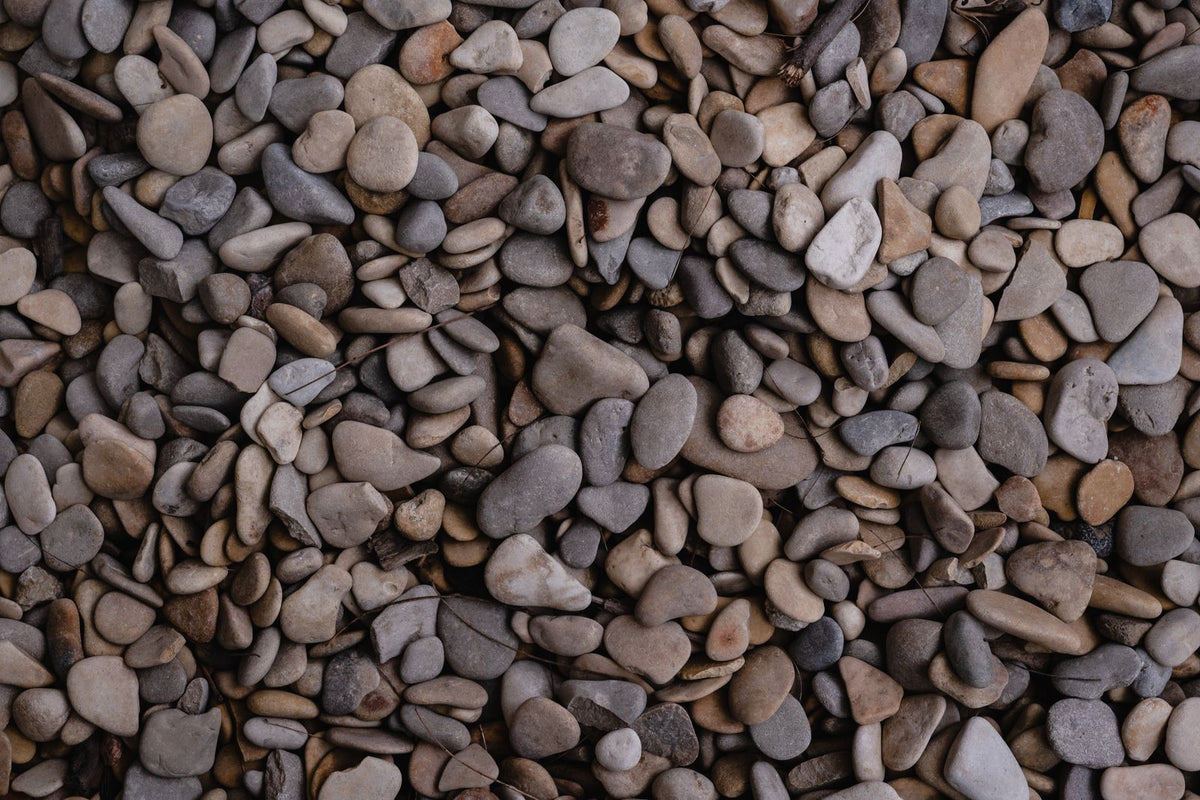
River rock is rounded, tumbled stone, and at 1"-3" it runs about 1.32 tons per cubic yard. One ton covers roughly 82 square feet at 3 inches, so a 200 square foot bed takes a little under two and a half tons.
For a ring around a tree or a shrub, set the shape to Ring or island bed: it subtracts the bare circle, so a 12 ft ring with a 3 ft gap at the center comes back as 1.43 tons at 3 inches, buffer included, rather than the 1.52 tons a full circle would take.
It works in beds and borders, dry creek beds, the strip against the house a mower cannot reach, and slopes where mulch washes away. It does not work where you walk regularly, because rounded stone rolls underfoot.
Rock adds nothing to the soil and traps leaves that rot into a layer weeds grow in. If the area is lawn today, read lawn alternatives first; the grass seed calculator covers the other direction. For a strip alongside a drive, see driveway landscaping. To reclaim rock from an old bed, a rolling garden sifter separates soil and leaf litter.
How much does a yard of landscape rock weigh?
Between about 2,500 and 3,000 lb for most decorative stone, or 1.25 to 1.5 tons dry. Lava rock is the outlier at roughly half that.
| Material | Density | Pounds per cubic yard | Tons per cubic yard |
|---|---|---|---|
| River rock (1"-3") | ~98 lb/ft³ | ~2,646 lb | ~1.32 tons |
| River rock, large (3"-5") | ~95 lb/ft³ | ~2,565 lb | ~1.28 tons |
| Cobbles (4"-8") | ~100 lb/ft³ | ~2,700 lb | ~1.35 tons |
| Decorative rock chips (1/4"-2") | ~105 lb/ft³ | ~2,835 lb | ~1.42 tons |
| Lava rock (3/8"-2") | ~45 lb/ft³ | ~1,215 lb | ~0.61 tons |
The practical consequence is the load limit. A half-ton pickup reaches its payload at roughly half a cubic yard of river rock, about 1,323 lb. Two cubic yards is a delivery.
Bags or bulk?
Bagged rock is sold two ways, and they are not interchangeable. A 0.5 cu ft bag is a volume, so it holds the same amount of any stone. A 50 lb bag is a weight, so it holds less of a heavy rock. That is why a cubic yard is 53 bags of river rock at 50 lb but only 25 bags of lava rock.
| Bag | Per cubic yard of river rock | Per cubic yard of lava rock | One bag covers at 3" (river rock) |
|---|---|---|---|
| 0.5 cu ft | 54 bags | 54 bags | ~2.0 sq ft |
| 0.4 cu ft | 68 bags | 68 bags | ~1.6 sq ft |
| 50 lb | 53 bags | 25 bags | ~2.0 sq ft |
| 40 lb | 67 bags | 31 bags | ~1.6 sq ft |
The break-even sits near one cubic yard, about 1.3 tons of river rock. Below half a yard, bags win: no delivery fee, no minimum, and you carry them a few at a time. Above a yard, that is fifty-odd bags to lift twice, and bulk is cheaper per ton even after delivery. Most yards set a one-ton minimum.
How much does landscape rock cost?
Most decorative stone sits between $50 and $220 per ton before delivery, and the spread is color and size rather than quality. Bagged rock runs $4 to $8 for a 0.5 cu ft bag, two to three times the bulk price per ton. Typical US ranges:
| Material | Per ton | Per cubic yard |
|---|---|---|
| River rock (1"-3") | $50-$160 | $65-$210 |
| Lava rock (3/8"-2") | $115-$220 | $70-$135 |
The per-cubic-yard column is the per-ton price converted at the densities in the weight table, which is why lava rock costs the most per ton but not per yard. Delivery adds $50 to $150 a load. Enter your own quote and the calculator prices the exact tonnage.
What is the cheapest landscape rock?
Small chips of whatever stone is quarried near you. Hauling is a large share of the price, so the cheapest material is the one that did not travel far, and cost falls as the stone gets smaller. Of the materials on this page, river rock from a local yard is usually the lowest, from about $50 a ton.