
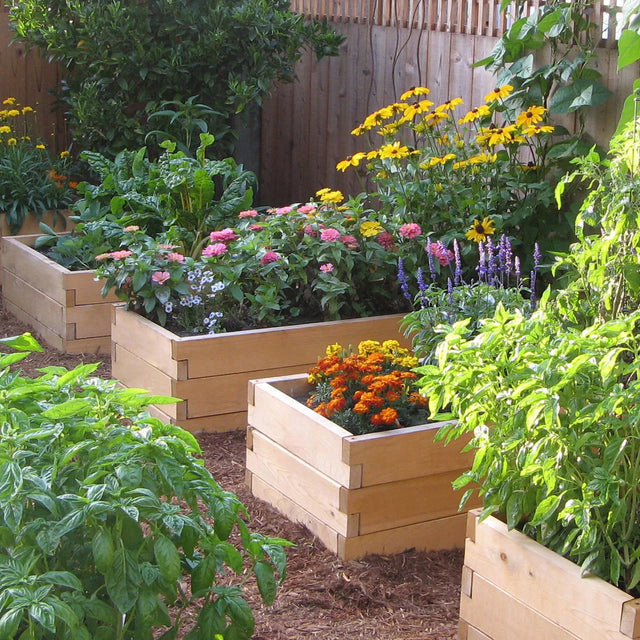
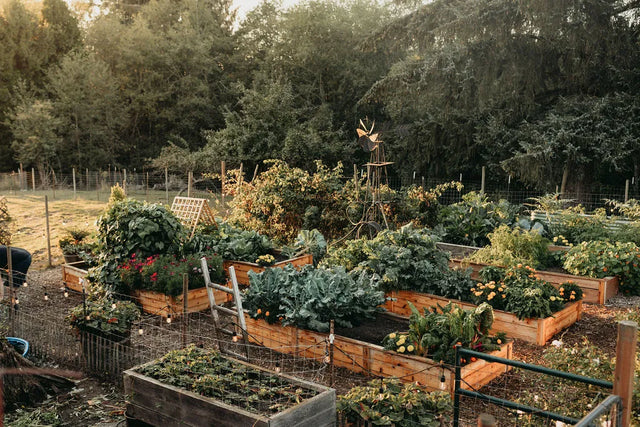


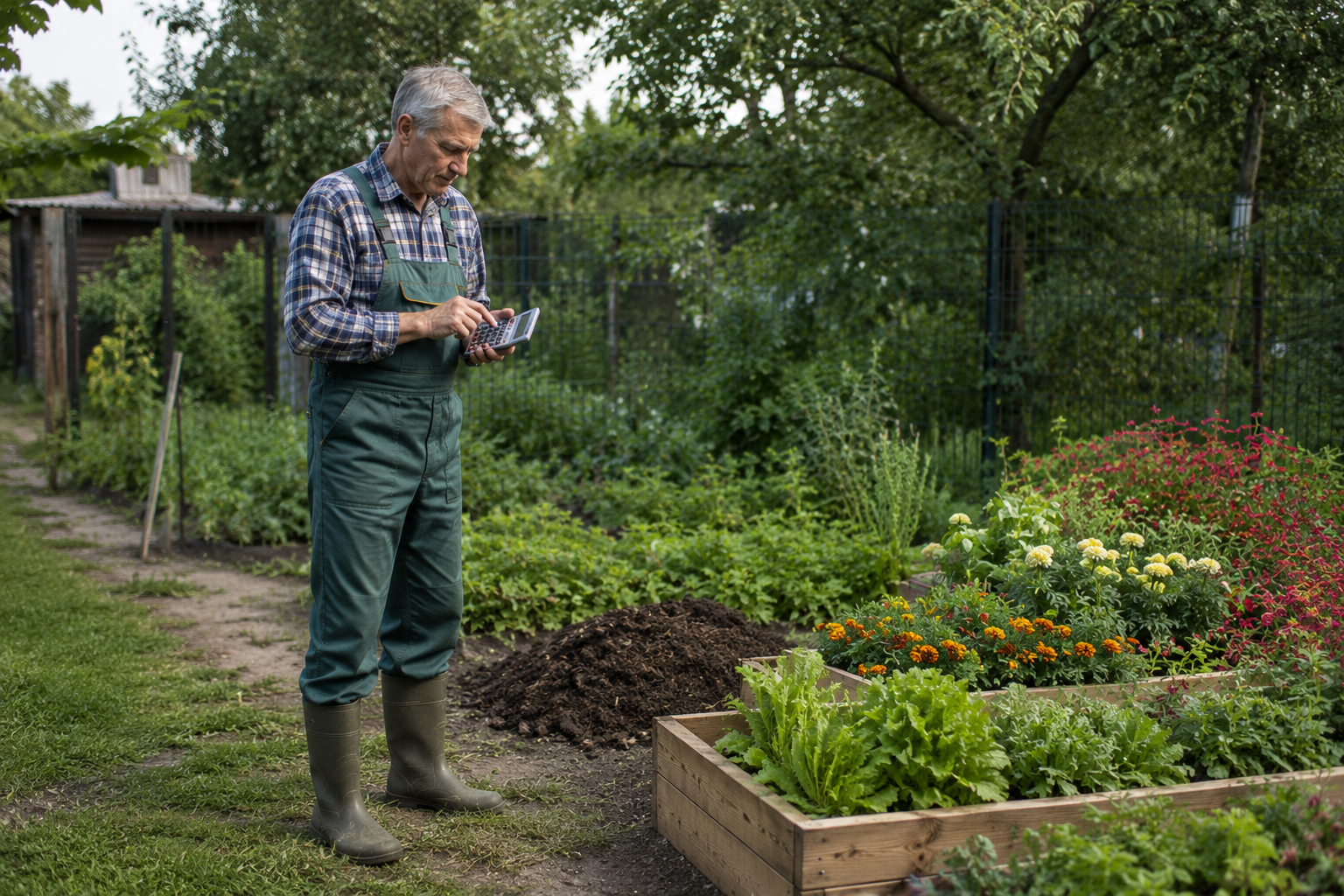
How much soil do I actually need? This soil calculator does the math for you. Enter the shape and size of your raised bed, pot or planter, and it returns the total volume in cubic yards and cubic feet, plus a ready-to-buy breakdown of soil, compost and potting mix — no guesswork, and no wheelbarrows of leftover soil hardening in the driveway.
1. Choose a garden bed or planter style
2. Select the shape
3. Enter the measurements
How much do you need?
Your ideal soil mix:

How to use this soil calculator
- Choose your style. Pick Raised Garden Bed (length and width in feet, depth in inches) or Pot / Elevated Planter (all dimensions in inches).
- Select the shape of your bed — square, rectangle, hexagon, octagon, L-shape or U-shape. For an L- or U-shaped bed, measure each rectangular section separately.
- Enter your measurements. Length, width and depth. Depth is how deep you want the soil — not the full height of the raised bed or the planter’s legs.
- Hit Calculate. You’ll see the total in cubic yards and cubic feet, plus a suggested 50% soil / 30% compost / 20% potting mix split.
How deep should your raised bed soil be?

Depth is the number people get wrong most often. Match it to what you’re growing:
| What you’re doing | Recommended soil depth |
|---|---|
| Refreshing / top-dressing an existing bed | 2–4 inches of new mix |
| Herbs, lettuce and other shallow-rooted greens | 6–8 inches |
| Most vegetables (tomatoes, peppers, beans, squash) | 10–12 inches |
| Deep-rooted crops (carrots, parsnips, potatoes) | 18–24 inches |
| Pots & containers | Fill to about 1 inch below the rim |
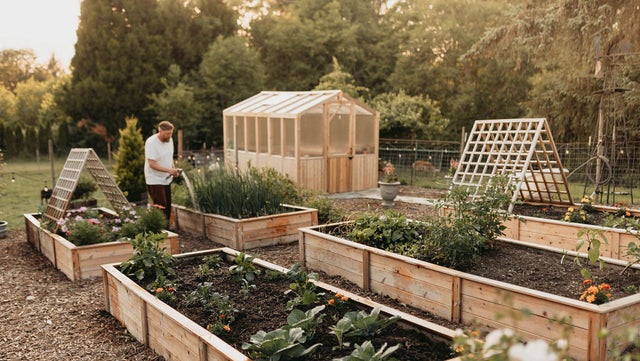
If your bed sits on grass or soil rather than a hard surface, roots can grow deeper than the bed itself — so you rarely need to fill a tall bed all the way for vegetables. Filling only the soil depth you need (not the full height of the bed) is the single biggest way to cut your soil cost. Browse raised garden beds sized for the depth your crops actually want.
Building over concrete or pavement instead? Lay a drainage layer under the bed first — calculate the gravel for your drainage layer before you fill.
The best soil mix for a raised bed

A raised bed is only as good as what you put in it. Don’t fill it with bagged “topsoil” or native dirt alone — it compacts, drains poorly and starves your plants. Eartheasy’s recommended blend, and the one this calculator splits your total into, is:
- 50% quality soil — a screened garden or raised-bed soil as the base and structure.
- 30% compost — the engine of a living, fertile bed. It feeds soil microbes, holds moisture and releases nutrients slowly, so you lean far less on synthetic fertilizer. Buy it, or make your own and never run out.
- 20% potting mix or aeration — material like coconut coir keeps the blend light and well-drained so roots get oxygen.
Prefer a different recipe? Two other popular ones work well: the classic 60% topsoil / 30% compost / 10% aeration, and Mel’s Mix from Square Foot Gardening (equal thirds of compost, peat or coir, and coarse vermiculite). The principle is the same — roughly half structure, a generous share of compost, and something to keep it airy. For step-by-step blends, see 3 useful soil mixes for planters and raised beds.
Topsoil vs. garden soil vs. potting mix vs. compost
These get used interchangeably at the store, but they’re not the same thing:
- Topsoil — the screened upper layer of natural earth. Cheap, heavy, general-purpose. On its own it compacts in a raised bed; use it as part of a blend.
- Garden soil — topsoil already amended with compost and nutrients, meant for in-ground beds. Usually too dense by itself for a tall container.
- Raised bed mix — a lighter, pre-blended product made for above-ground beds: better drainage and structure than plain garden soil.
- Potting mix / potting soil — a soilless blend (coir or peat, perlite, bark) for pots and containers. Won’t compact and drains fast, but dries out quicker too.
- Compost — decomposed organic matter. Not a standalone growing medium, but the most important amendment you can add: it improves drainage and moisture retention and feeds the soil’s microbiology.
Know your soil type before you buy in bulk — it tells you what your blend actually needs.
Soil for pots, planters & odd-shaped beds

Not every garden is a tidy rectangle, and the calculator is built for that.
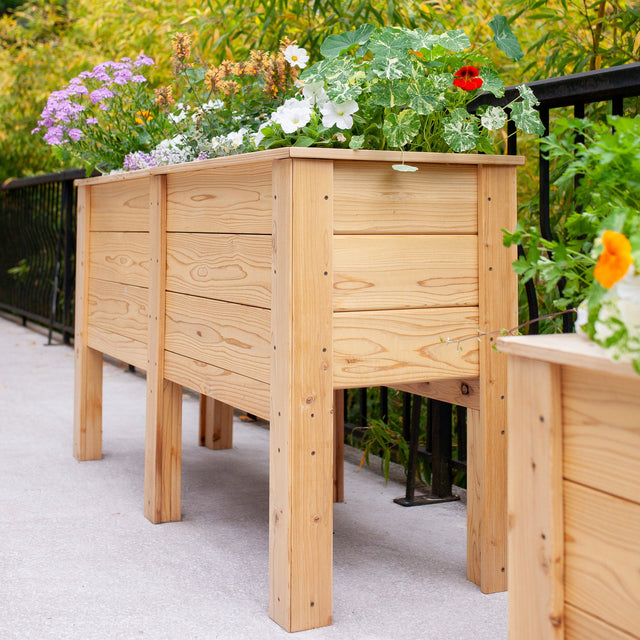
- Pots & elevated planters — switch the style to Pot / Elevated Planter and enter all dimensions in inches; it doubles as a potting soil calculator for containers. Fill to about an inch below the rim, and lean a little heavier on potting mix so containers don’t get waterlogged. See Eartheasy’s planters and elevated beds.
- L-shaped and U-shaped beds — most calculators can’t handle these. This one treats the bed as two (L) or three (U) rectangles: measure each section, enter them, and it adds the volumes for you.
- Hexagon and octagon beds — enter the side length; the calculator applies the correct geometry so you’re not over-buying.
How many bags of soil do I need?
Bagged soil is sold by volume, so once you know your cubic feet you can read the bags straight off this table:
| Bag size | Volume per bag | Bags per cubic yard |
|---|---|---|
| Small (≈ 40 lb) | ~0.75 cu ft | 36 |
| 1 cu ft bag | 1 cu ft | 27 |
| 1.5 cu ft bag | 1.5 cu ft | 18 |
| 2 cu ft bag | 2 cu ft | 14 |
Bags are labelled by volume, not weight: a 40 lb bag is about 0.75 cu ft of compost or potting mix. Always go by the cubic-foot figure printed on the bag, since denser topsoil weighs more for the same volume.
Bulk vs. bagged — which to buy?
- Bagged is easiest for one or two beds, balcony planters, or anyone without a truck. You can carry and store it, and only open what you need.
- Bulk (by the cubic yard) is far cheaper once you pass roughly 2 cubic yards — about a single 4×8 bed at full depth plus a few pots. You usually don’t need a delivery truck — a standard pickup holds about 1–2 cubic yards in the bed (just mind the weight: a full yard of damp topsoil is already a heavy load — see the weight guide below). Bring a wheelbarrow to move it, and the price-per-yard drops sharply.
A rough rule: under 1 yard, buy bags; 1 yard and over, pick up with a standard truck or arrange delivery.
Soil needed by raised bed size
Quick reference for the most common bed footprints — a raised bed soil calculator cheat-sheet for when you just want a number. Volumes are for the whole bed at two typical depths; bag counts assume 1.5 cu ft bags.
| Bed size | Soil at 6″ | Soil at 12″ | 12″ in cubic yards | 1.5 cu ft bags (12″) |
|---|---|---|---|---|
| 2 ft × 4 ft | 4 cu ft | 8 cu ft | 0.30 cu yd | 6 |
| 4 ft × 4 ft | 8 cu ft | 16 cu ft | 0.59 cu yd | 11 |
| 3 ft × 6 ft | 9 cu ft | 18 cu ft | 0.67 cu yd | 12 |
| 3 ft × 8 ft | 12 cu ft | 24 cu ft | 0.89 cu yd | 16 |
| 3 ft × 9 ft | 13.5 cu ft | 27 cu ft | 1.0 cu yd | 18 |
| 4 ft × 8 ft | 16 cu ft | 32 cu ft | 1.19 cu yd | 22 |
| 4 ft × 12 ft | 24 cu ft | 48 cu ft | 1.78 cu yd | 32 |
Not on the list? Enter your exact dimensions in the calculator above — it works for any size and all six shapes.
How much does your soil weigh?
A cubic yard of garden soil weighs roughly 1,800–2,200 pounds (about 0.9–1.1 US tons), and screened topsoil is heavier still. Weight matters the moment you buy in bulk: suppliers sell by the ton, pickups have a payload limit, and every cubic foot is one more wheelbarrow trip. Here’s what each material weighs.
| Material | lb / cu ft | lb / cu yd | tons / cu yd | Notes |
|---|---|---|---|---|
| Screened topsoil | 74–82 | 2,000–2,200 | 1.0–1.1 | Heaviest; wet can reach ~2,500 lb (1.25 t). |
| Garden soil | 67–82 | 1,800–2,200 | 0.9–1.1 | Topsoil plus amendments. |
| Raised-bed / garden mix | 56–70 | 1,500–1,900 | 0.75–0.95 | Lighter, free-draining blend. |
| Compost | 37–52 | 1,000–1,400 | 0.5–0.7 | Moisture-dependent; wet is 30–50% heavier. |
| Potting mix | 15–33 | 400–900 | 0.2–0.45 | Lightest dry; soaks up water and gets much heavier. |
| 50 / 30 / 20 blend (this calculator’s mix) | 48–63 | 1,300–1,700 | 0.65–0.85 | Lighter than straight topsoil — easier to barrow. |
How these are figured: values use common published bulk densities for landscape materials, given as ranges because real weight swings with moisture, screening and compaction. We assume 1 cubic yard = 27 cubic feet and 1 US ton = 2,000 lb, so tons = (lb per cu yd) ÷ 2,000 and lb per cu ft = (lb per cu yd) ÷ 27. The 50/30/20 row is the volume-weighted average of its parts. Always confirm with your supplier — wet material can run 20–50% heavier than the dry figures here.
What that means for your bed
Take the worked example from above — a 4 ft × 8 ft bed filled 12″ deep = 1.2 cubic yards (32 cubic feet). Filled with the recommended 50/30/20 blend that’s about 1,560–2,040 lb (roughly 0.8–1.0 ton); in pure screened topsoil it climbs to ~2,400–2,640 lb (1.2–1.3 tons). In practice:
- Wheelbarrow: at about 3 cubic feet of soil per load, that’s roughly 11 trips from the driveway to the bed.
- Pickup: a topsoil fill (~1.3 ton) tops the safe payload of many “half-ton” trucks (often ~1,000–2,000 lb — check yours). The lighter blend (~0.9 ton) is friendlier, but still a full load.
- Car: bagged only — 32 cubic feet is about 43 bags of 0.75 cu ft, far more than a trunk holds, so plan several trips or a delivery.
How to calculate soil volume (the formula)
The soil calculator above works as a garden soil calculator for any bed, pot or planter and does this automatically — but here’s the math behind it so you can sanity-check any result. Soil volume is simply area × depth, with every measurement converted to feet first:
Volume (cubic feet) = length (ft) × width (ft) × depth (ft) depth (ft) = depth in inches ÷ 12 Volume (cubic yards) = cubic feet ÷ 27A cubic yard is 27 cubic feet — picture a cube three feet on every side. It’s the unit bulk soil is sold in, so it’s the number to quote when you order a delivery.
Worked example — a 4 ft × 8 ft raised bed, filled 12 inches deep:
depth = 12 in ÷ 12 = 1 ft volume = 4 × 8 × 1 = 32 cubic feet cubic yards = 32 ÷ 27 = 1.2 cubic yardsSo that bed needs about 1.2 cubic yards of soil mix. Round, hexagonal and octagonal beds use the standard area formula for that shape; L- and U-shaped beds are added up section by section — the calculator handles all of them.
Frequently asked questions
How much soil do I need for a raised bed?
How many bags of soil do I need?
How deep should the soil be in a raised bed?
What is the best soil mix for a raised bed?
What’s the difference between topsoil, garden soil, potting mix and compost?
How big is a cubic yard of soil?
How much soil do I need for a planter or pot?
Can I reuse old raised bed or potting soil?
How do I calculate soil for an L-shaped or U-shaped bed?
Should I buy soil in bags or in bulk?
Related reading
 How to Calculate Soil Volume for Raised Garden BedsThe formulas behind the calculator — for square, L, U, hexagon and octagon beds, worked by hand.
 3 Useful Soil Mixes for Planters and Raised BedsThree blend recipes — simple, luxury and lasagna — plus how to match them to what you're growing.
 A Year-Round Guide to Raised Garden BedsSeason-by-season tasks that keep beds productive from spring set-up through winter planning.
 12 Things to Consider Before Installing a Raised BedLocation, depth, materials, drainage and cost — the questions to settle before you build.
 Easy Planting Plans for Raised Garden BedsTen ready-made layouts — from a classic veg bed to a cut-flower garden — with spacing and timing.
 How to Choose the Right ComposterBins, tumblers, worm systems or digesters — match the type to your space and what you'll compost.