















By Greg Seaman
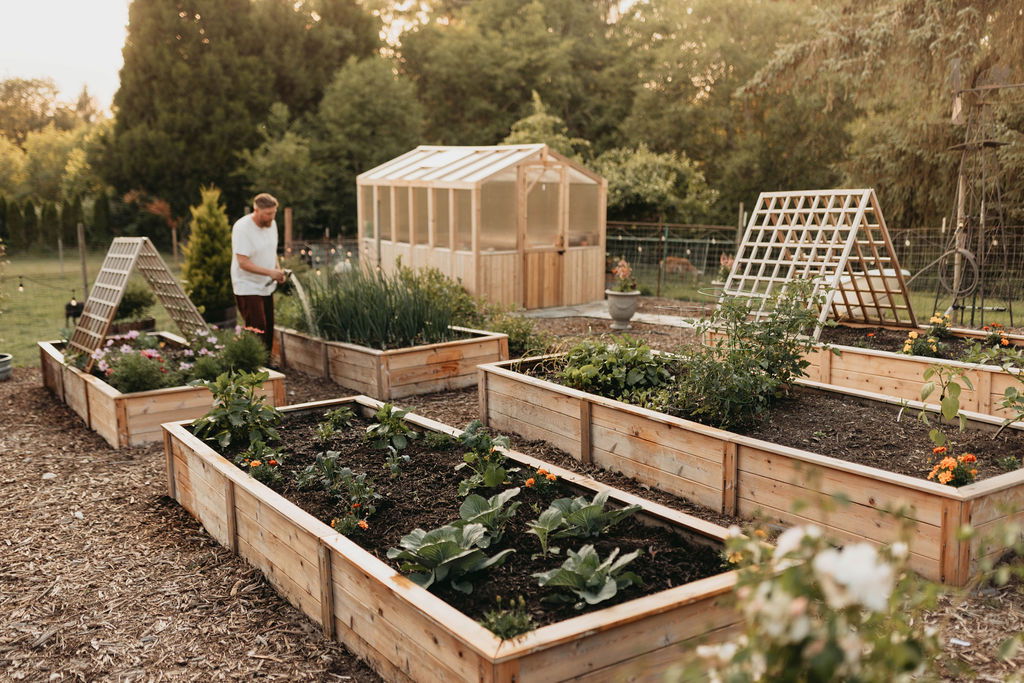
The most important part of setting up a new raised garden bed is getting the soil right, but few gardeners have extra soil lying around to fill their beds. By using simple volume formulas based on your bed's shape and dimensions, you can calculate exactly how much soil to order, saving both time and money while ensuring your plants have the depth they need to thrive.
Key takeaways
- Calculate exact soil amounts by multiplying length, width and height to avoid ordering too much or too little for your raised beds.
- Square and rectangular beds use straightforward multiplication, while L-shaped, U-shaped, and hexagonal beds need multi-step calculations.
- Always use the same unit (feet or inches) throughout your calculations, then convert to cubic yards for ordering.
WHY SOIL VALUE CALCULATION MATTERS UNITS & CONVERSIONS: WHAT YOU NEED TO KNOW FORMULAS & HOW-TO FOR COMMON BED SHAPES QUICK REFERENCE TABLE: COMMON RAISED BED SIZES WORKED EXAMPLES & SAMPLE CALCULATIONS ALLOWANCE FOR SETTLING & SOIL COMPACTION – WHY AND HOW MUCH TO ADD SOIL MIX, TYPE & WEIGHT CONSIDERATIONS WHAT TO DO AFTER FILLING FAQ & TROUBLESHOOTING FURTHER RESOURCES & REFERENCES
Since few of us have extra garden soil hanging around our backyards, many of us need to buy enough to fill raised beds before planting. But how do you know how much soil to avoid waste?
Thankfully there are formulas for calculating soil volume that can help you know exactly what you need based on the size and shape of your bed. If you are looking to calculate the amount of soil needed for a raised bed, read on for simple, step-by-step instructions for the most common raised bed types.
Why soil volume calculation matters
Calculating soil volume for your raised garden beds isn't just about avoiding leftovers—it's essential for successful gardening. Understanding your soil needs helps you budget, since soil can be one of the more expensive initial investments in a raised bed garden. Ordering the right amount means you won't face the inconvenience and added cost of a second delivery or the waste and storage hassle of an over-order.
Beyond the practical benefits, proper soil volume calculation ensures your plants have adequate depth for healthy root development. Different plants require different soil depths. Knowing your bed's exact capacity helps you plan what to grow where. Filling your beds to the appropriate level also prevents settling issues that can leave plants struggling in shallow pockets of soil as organic matter decomposes over time.
Callout:
The most important part of a new raised garden bed is the soil that goes inside.
Units & conversions: What you need to know
When calculating soil volume, it’s important to keep your units consistent from start to finish. Measure your bed dimensions in the same units (feet, inches or metres), then convert the final volume into what soil is sold in—typically cubic feet, cubic yards, or litres. A few simple conversions can save you from buying too much (or too little) soil.
Formulas & how-to for common bed shapes
Below we’ve used the most straightforward formulas for calculating soil volume. Sample calculations for each bed type walk you through converting units where necessary.
Rectangular beds
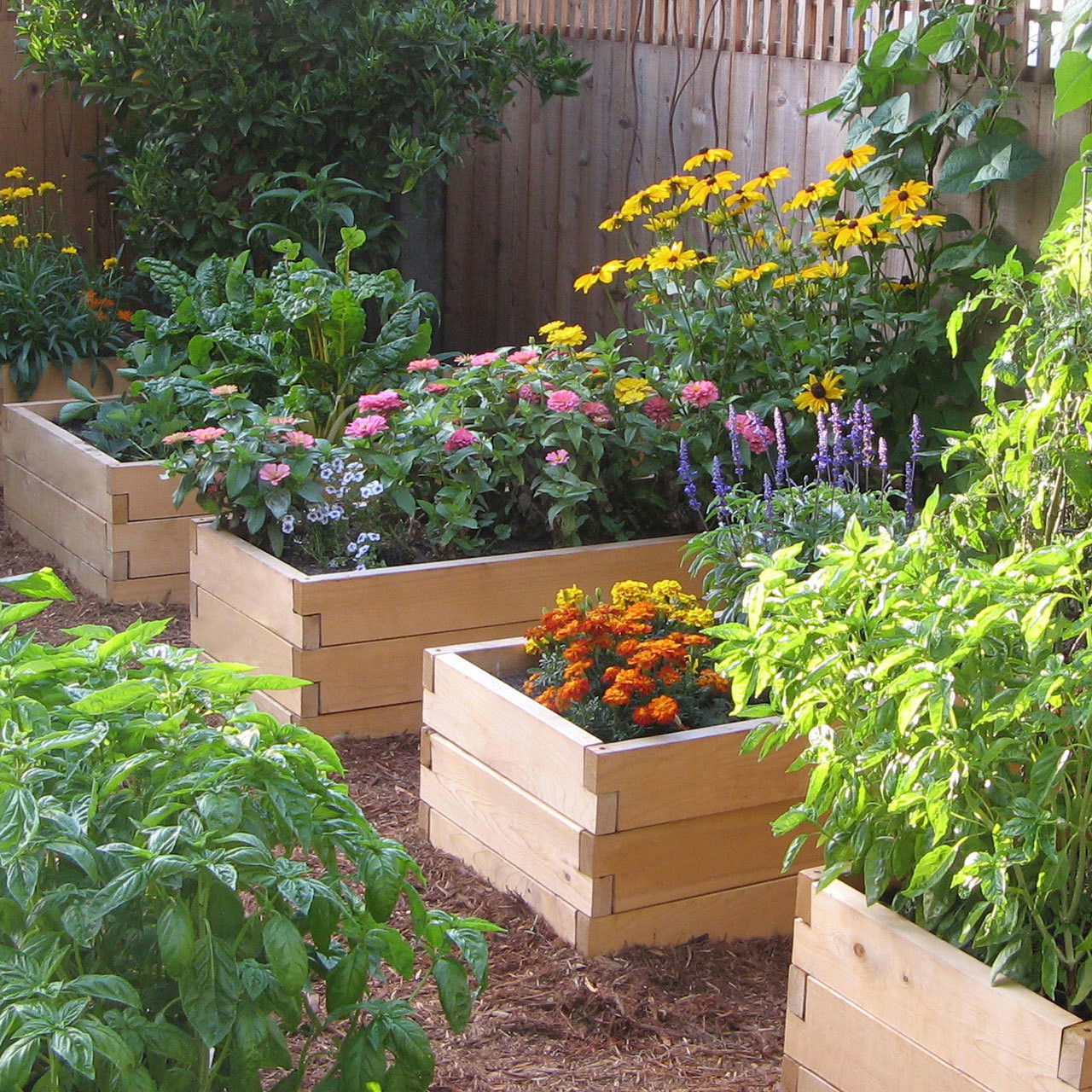
The formula for soil volume in square or rectangular beds is the easiest to calculate–no instant garden soil calculator needed. It involves only three measurements: the length, width and height of your bed.

Natural Cedar Raised Garden Beds
Use the formula below:
V = L x W x H
V stands for soil volume
L stands for your bed’s length
W stands for your bed’s width
H stands for the height of your bed

To calculate:
- Measure the length, width and height of your bed. (Unless the boards are very thick, don’t worry about inside/outside measurements.) Convert all measurements to the same unit. For example, if your bed is 6 feet long, 3 feet wide and 16.5 inches high, convert the inches to feet so your new measurements are 6 x 3 x 1.4 feet.
- Multiply all the measurements together: 6 x 3 x 1.4 = 25.2 cubic feet.
- Divide the answer by 27 to get the number of cubic yards. In the example above, your bed would need 0.9 cubic yards of soil.
L-shaped bed
Finding the soil volume for an L-shaped bed involves another step, but it’s still relatively simple. Start by dividing your bed into two figures with four sides each. For example:

Once you have the measurements for these two figures, use the formula above for rectangles to calculate each figure separately. Add the totals together.
V = (L x W x H) + (L x W x H)
V = (6 x 3 x 1.4) + (3 x 3 x 1.4)
V = 25.2 + 12.6
V = 37.8 ft3
To convert to cubic yards, divide by 27.

Natural Cedar L-Shaped Raised Garden Beds
The total is 1.4 cubic yards.
U-shaped bed
Using the same premise as above, divide your U-shaped bed into three figures and calculate each one using the formula for squares and rectangles. For example:

V = (L x W x H) + (L x W x H) + (L x W x H)
V = (9 x 4 x 1.4) + (3 x 4 x 1.4) + (3 x 4 x 1.4)
V = 50.4 + 16.8 + 16.8
V = 84 ft 3
To convert to cubic yards, divide by 27.

Natural Cedar 12' U-Shaped Raised Garden Beds
The total is 3.1 cubic yards.
Regular hexagonal bed
Hexagonal raised beds form a shape called a hexagonal prism. These beds come as regular hexagons (where all the sides are the same size) and irregular hexagons (where all the sides aren’t the same size). To calculate the volume of soil needed to fill a regular hexagonal prism, use the following formula.

Natural Cedar Hexagon Raised Beds
V= 3/2 (√3) s2h
V equals the total soil volume
S equals the length of one side of the regular hexagon
H equals the height of the bed

Here’s an example for the image above:
V= 3/2 (√3)(32)(2)
V = 46.77 ft3
Divide by 27 for 1.73 cubic yards.
For a shortcut you can try this online calculator for regular hexagonal prisms.
Regular octagonal bed
Octagonal raised beds form a shape called an octagonal prism. As above, these beds come as regular octagons (where all the sides are the same size) and irregular octagons (where all the sides aren’t the same size). To calculate the volume of soil needed to fill a regular octagonal prism, use the following formula.
V = 2 (1 + √2) S2H
V equals the total soil volume
S equals the length of one side of the regular octagon
H equals the height of the bed

Here’s an example for the bed pictured above:
V = 2 (1 + √2)(32)(1.4)
V = 60.84 ft3
Divide the total by 27 to get 2.3 cubic yards.

Natural Cedar Octagon Raised Beds
To instantly calculate regular octagonal volume, try this online calculator.
Irregular/Custom/Curved beds
If you’re comfortable with a volume estimate, you can treat your long octagon (or hexagon) as a rectangle measured from its longest point and use the formula above to gauge how much soil you’ll need to fill a corresponding four-sided figure.

If you want to be more exact, you have another option. A straightforward way to find the volume of any irregular prism is to first calculate the area of the base and then multiply that measurement by the height. If you have a long hexagon or octagon, you can separate the base into triangles and a rectangle and calculate the area for each. After adding them together for the base area, multiply this total by the height. This will give you the cubic measurement you’ll need for soil volume. (To calculate area of a triangle, use ½ the base multiplied by the height).
Quick reference table: Formulas for common raised bed sizes
|
Bed Shape |
Formula (soil volume) |
Notes |
|
Rectangular / Square |
V = L × W × H |
Use internal measurements if walls are thick; convert units consistently |
|
L‑shaped |
V = Rect1 + Rect2 |
Break down into two rectangles, add volumes |
|
U‑shaped |
V = Rect1 + Rect2 + Rect3 |
Break down into three rectangles, add volumes |
|
Regular Hexagon |
V = (3/2) √3 × s² × H |
s = length of a side |
|
Regular Octagon |
V = 2(1 + √2) × s² × H |
s = side length |
|
Irregular Shapes |
Calculate base area (by splitting into simpler shapes) × Height |
Use triangles/rectangles; or approximate as nearest rectangle |
Other bed shapes and configurations with sample calculations
Understanding the formulas is one thing, but seeing them applied to real-world scenarios helps ensure you order the right amount of soil. Here are detailed examples for various bed configurations, from simple rectangles to more complex shapes.
Example 1: L-shaped bed with mixed measurements
You've built an L-shaped bed where the long section is 10 feet by 3 feet, the short section is 4 feet by 3 feet, and both sections are 20 inches high.
Step 1: Convert all measurements to feet. Height: 20 inches ÷ 12 = 1.67 feet.
Step 2: Split the shape into two rectangles.
- Rectangle 1: 10 feet × 3 feet × 1.67 feet
- Rectangle 2: 4 feet × 3 feet × 1.67 feet
Step 3: Calculate each section.
- Section 1: 10 × 3 × 1.67 = 50.1 cubic feet
- Section 2: 4 × 3 × 1.67 = 20.04 cubic feet
Step 4: Add sections together: Total = 50.1 + 20.04 = 70.14 cubic feet
Step 5: Convert to cubic yards: 70.14 ÷ 27 = 2.6 cubic yards
Step 6: Adjust for ordering. Round up to 3 cubic yards for bulk delivery, or purchase 36 bags of 2-cubic-foot bagged soil (70.14 ÷ 2 = 35.07, rounded to 36).
Example 3: Tiered or multi-level bed
You're creating a tiered bed with two levels: the bottom tier is 8 feet × 4 feet × 12 inches, and the top tier (sitting on top) is 4 feet × 4 feet × 12 inches.
Step 1: Convert heights to feet. Both heights: 12 inches ÷ 12 = 1 foot.
Step 2: Calculate each tier separately.
- Bottom tier: 8 × 4 × 1 = 32 cubic feet
- Top tier: 4 × 4 × 1 = 16 cubic feet
Step 3: Add tiers together Total = 32 + 16 = 48 cubic feet.
Step 4: Convert to cubic yards 48 ÷ 27 = 1.78 cubic yards.
Step 5: Adjust for ordering Order 2 cubic yards for bulk delivery, or 24 bags of 2-cubic-foot soil.
Example 3: Keyhole garden bed
A keyhole garden has a circular outer bed with a circular path cut into it. The outer circle is 8 feet in diameter, the inner keyhole path is 2 feet in diameter, and the bed height is 2 feet.
Step 1: All measurements are already in feet. No conversion needed.
Step 2: Calculate the area of the outer circle. Radius of outer circle = 8 ÷ 2 = 4 feet Area = π × r² Area = 3.14 × 4² = 50.24 square feet.
Step 3: Calculate the area of the inner circle (keyhole path). Radius of inner circle = 2 ÷ 2 = 1 foot Area = 3.14 × 1² = 3.14 square feet.
Step 4: Subtract inner from outer to get planting area. Planting area = 50.24 - 3.14 = 47.1 square feet.
Step 5: Multiply by height to get volume V = 47.1 × 2 = 94.2 cubic feet.
Step 6: Convert to cubic yards 94.2 ÷ 27 = 3.49 cubic yards.
Step 7: Adjust for ordering. Order 3.5 cubic yards (or round to 4 for safety) for bulk delivery, or 48 bags of 2-cubic-foot soil.
Example 4: Bed with thick walls
You have a 6-foot × 6-foot bed made from 6-inch thick timber walls, and it's 18 inches tall. You need the interior dimensions for accurate soil calculation.
Step 1: Calculate interior dimensions. Subtract wall thickness from each side:
- Interior length: 6 feet - (0.5 feet × 2) = 5 feet
- Interior width: 6 feet - (0.5 feet × 2) = 5 feet
- Interior height: 18 inches ÷ 12 = 1.5 feet
Step 2: Calculate volume using interior measurements V = 5 × 5 × 1.5 V = 37.5 cubic feet
Step 3: Convert to cubic yards 37.5 ÷ 27 = 1.39 cubic yards
Step 4: Adjust for ordering. Order 1.5 cubic yards for bulk delivery, or 19 bags of 2-cubic-foot soil (37.5 ÷ 2 = 18.75, rounded up).
Tips for all calculations:
- Always round up when ordering to ensure you have enough soil.
- Account for settling by adding an extra 10-15% to your total if using loose bulk soil.
- Keep your calculations and measurements handy for future reference or additional beds.
- When in doubt between two amounts, choose the larger quantity—leftover soil can always be used for container plants or top-dressing.
Knowing you have the right soil volume can save you time and money. By filling your beds adequately, you’ll not only make the best use of your space, you’ll give your plants the space they need to thrive.
Allowance for settling & soil compaction – why and how much to add
Even when you've calculated your soil volume precisely, you may find your raised bed isn't quite as full as expected after a few weeks. This is completely normal and happens for two key reasons: settling and compaction.
1. Why soil settles
Freshly delivered soil contains air pockets between particles, and loose organic matter hasn't yet begun to decompose. As you water your beds and plants establish roots, gravity naturally compacts the soil, squeezing out air spaces.
Rain, foot traffic near the bed, and the weight of the soil itself add to this settling over time. Organic materials like compost and peat moss are particularly prone to decomposition, which reduces their volume as microorganisms break them down.
2. How much extra to order
The amount of settling you'll experience depends on your soil mix composition:
- Standard garden soil mix (blend of topsoil, compost, and amendments): Add 10-15% extra
- High organic matter content (compost-heavy mixes): Add 15-25% extra
- Bulk delivery of loose soil: Add 10-15% extra
- Pre-bagged, compressed soil: Add 5-10% extra (these have already been compacted) For example, if your calculation shows you need 2 cubic yards of a compost-heavy mix, multiply 2 × 1.20 (adding 20%) = 2.4 cubic yards. Round up to 2.5 cubic yards when ordering.
3. Managing settling over time
Don't be alarmed if you need to top up your beds annually. This is standard practice for healthy raised bed gardening. Many gardeners add 1-2 inches of fresh compost each spring to replace lost volume and replenish nutrients. This regular top-dressing actually benefits your plants by maintaining soil structure and fertility. Keep some extra bagged soil or compost on hand for quick touch-ups throughout the growing season.
By accounting for settling from the start, you'll save yourself the frustration of an under-filled bed just as your seedlings are ready to transplant.
Soil mix, type & weight considerations
Not all soil is created equal. The type you choose affects more than just plant health—it impacts how much you'll need, what your bed can support, and how your calculations translate into actual delivery.
1. Understanding soil density
Different soil types have vastly different weights per cubic yard, which matters for both structural support and delivery logistics:
- Topsoil: 1,000-2,000 lbs per cubic yard
- Compost: 1,000-1,400 lbs per cubic yard
- Potting mix or soilless mix: 300-800 lbs per cubic yard
- Garden soil blend (topsoil + compost + amendments): 1,200-1,800 lbs per cubic yard
- Sand or gravel (if using for drainage layers): 2,400-2,700 lbs per cubic yard
A standard 4×8 raised bed that's 2 feet tall holds roughly 2.4 cubic yards of soil. If filled with heavy topsoil, that's nearly 5,000 pounds—over two tons of weight your bed structure needs to support.
2. Structural considerations
Before ordering, consider your bed's construction:
- Lightweight cedar or pine beds work well with lighter potting mixes or balanced garden blends
- Heavy topsoil requires sturdy construction with proper bracing, especially for beds over 12 inches tall
- Beds on rooftops, balconies, or decks need lightweight soilless mixes to stay within weight limits
- Sloped locations may need heavier soil mixes to resist erosion and shifting
3. How soil type affects volume calculations
While your volume calculation remains the same regardless of soil type, the practical application differs:
- Lightweight mixes (potting soil, soilless blends) tend to settle more and may require 15-20% extra to account for compaction. They're ideal for container-style raised beds and situations where weight is a concern.
- Heavy topsoil settles less dramatically but is much harder to work with and transport. If you're filling multiple beds, consider whether you can physically manage the weight.
- Blended garden mixes (often called "raised bed mix" or "garden blend") offer the best balance. They typically combine topsoil for stability, compost for nutrients, and lighter amendments like peat moss or coconut coir for drainage. These usually require a 10-15% settling allowance.
4. Ordering by weight vs. volume
Most soil is sold by cubic yard, but some suppliers price by weight (ton). To convert:
- 1 ton = 2,000 lbs
- Divide the weight per cubic yard by 2,000 to find tons per cubic yard
- Example: Garden blend at 1,500 lbs/cubic yard = 0.75 tons per cubic yard
- If you need 3 cubic yards: 3 × 0.75 = 2.25 tons
5. Moisture content matters
Wet soil weighs significantly more than dry soil—sometimes 25-30% more. This affects:
- Delivery weight and potential surcharges
- Your ability to spread and work the soil
- Settling rates (wet soil compacts more initially)
If possible, order soil during dry weather and request it be delivered "on the dry side" for easier handling.
6. Creating your own mix
If mixing your own soil, a popular ratio for raised beds is:
- 40% topsoil
- 40% topsoil
- 20% drainage material (perlite, vermiculite, or coconut coir)
Calculate each component separately based on your total volume, then order accordingly. For a bed needing 3 cubic yards total:
- Topsoil: 3 × 0.40 = 1.2 cubic yards
- Compost: 3 × 0.40 = 1.2 cubic yards
- Drainage material: 3 × 0.20 = 0.6 cubic yards
Remember to add your settling allowance (10-15%) to the total before ordering.
What to do after filling
Once your raised bed is filled with soil, a few key steps will ensure it's ready for planting success.
1. Allow time for settling
Give your bed one to two weeks to settle before planting. Water thoroughly several times during this period to eliminate air pockets—you'll likely see the soil level drop by an inch or two. Top up any low spots with additional soil as needed.
2. Test your soil
Before planting, check your soil's pH (most vegetables prefer 6.0-7.0) and do a simple drainage test by watering thoroughly. The water should soak in within a few hours. If amendments are needed, mix them in now while the bed is empty.
3. Prepare for ongoing maintenance
Expect gradual settling throughout the first growing season. Keep extra bagged soil or compost on hand for touch-ups, and plan to top-dress with 1-2 inches of fresh compost each spring to maintain soil level and fertility.
4. Mulch after planting
Once plants are in the ground, apply 2-3 inches of organic mulch to retain moisture, suppress weeds, and moderate soil temperature.
FAQ & troubleshooting
1. My soil level dropped significantly after the first few weeks. Did I calculate wrong?
Probably not. Settling of 10-25% is completely normal, especially with compost-heavy mixes or loose bulk soil. Simply top up the bed with additional soil or compost. This is why we recommend adding 10-15% extra when initially ordering.
2. I'm between two amounts—should I round up or down when ordering?
Always round up. Leftover soil can be used for container plants, top-dressing existing beds, or stored (covered) for future touch-ups. Running short means additional delivery fees or multiple trips to the garden center.
3. Can I fill the bottom of my bed with something other than soil to save money?
Yes, for beds taller than 24 inches. The bottom 6-8 inches can be filled with coarse materials like shredded woody debris, leaves, straw. Just ensure the top 12-18 inches are quality soil for root growth. Don't use this method for shallow beds.
4. My calculations show I need 2.3 cubic yards, but the supplier has a 3-yard minimum. What should I do?
Take the full 3 yards. Use the extra to top-dress your bed generously, fill containers, or amend other garden areas. Alternatively, ask neighbors if they'd like to split a delivery.
5. The soil I ordered looks different from what I expected. Should I be concerned?
Soil varies in color and texture based on composition. Dark, crumbly soil with visible organic matter is good. Red flags include: strong chemical or rotten smell, excessive clay that forms hard clumps, visible pebbles or rocks, or soil that's soaking wet and impossible to work with. Contact your supplier if you have concerns.
6. Do I need to account for rocks or drainage layers in my calculation?
Yes. If you're adding a 2-inch gravel layer for drainage, subtract that from your soil depth. For example, an 18-inch tall bed with 2 inches of gravel needs soil calculated at 16 inches of height.
7. I have an oddly shaped bed that doesn't fit any of these formulas. What do I do?
Break it into simpler shapes (rectangles, triangles, circles) and calculate each section separately, then add them together. When in doubt, approximate using the longest and widest dimensions as a rectangle—you may have a little extra, but you won't run short.
8. My bed is on a slope. How do I calculate soil volume?
Measure the height at several points and use the average height in your calculation. For beds on significant slopes, you may need to measure each section separately if the height varies by more than a few inches.
9. Bagged soil vs. bulk delivery—which is better?
For beds needing less than 1 cubic yard, bagged soil is more convenient. For larger projects (2+ cubic yards), bulk delivery is more economical and environmentally friendly. Note that bagged soil is often pre-compressed, so you may need slightly less than calculated.
10. I filled my bed months ago and the soil has dropped again. Is this normal?
Yes. Organic matter continues to decompose, causing gradual settling over time. Many gardeners routinely add 1-2 inches of compost each spring. This is a feature, not a bug—it replenishes nutrients while maintaining soil volume.
11. Can I reuse the soil from last year's bed?
Yes, but refresh it first. Trim any remaining plants to soil level and top dress with fresh compost (about 30% by volume) to restore structure and nutrients.
12. My calculation seems too high. How can I verify it's correct?
Double-check that all measurements are in the same unit and that you're using the interior dimensions of your bed. Recalculate using the formulas provided, or use an online soil calculator as a second check. Remember, raised beds hold more soil than most people expect—a 4×8×2 foot bed needs nearly 2.5 cubic yards.
Further resources & references
From Eartheasy:
How to Build and Nourish Healthy Garden Soil
Comprehensive information on soil health and maintenance
How to Build a Raised Garden Bed on Sloping, Uneven Ground
Specialized techniques for challenging terrain
Gardening on Concrete With Raised Beds and Patio Containers
Solutions for urban and small-space gardening
Additional reading:
University Extension soil testing services
Check your local university's extension office for professional soil testing and recommendations
USDA Natural Resources Conservation Service - Soil Health
In-depth information on soil science and management
Soil suppliers & information:
Local landscape supply companies
Often provide delivery and can advise on appropriate soil mixes for your region
Bulk mulch and compost facilities
Typically offer economical options for large-scale projects
Garden centers
Convenient for smaller quantities and specialty soil blends
Conclusion
Calculating soil volume for your raised garden beds doesn't have to be complicated. Whether you're working with a simple rectangular bed or a more complex hexagonal design, using the right formula ensures you order exactly what you need—saving money, reducing waste, and giving your plants the proper depth to flourish.
Do you have pictures or stories about your raised beds to share? Leave a comment with us below!