















By Greg Seaman
Choosing the right depth for your raised beds is crucial for successful vegetable growing. This guide will show you how to determine the ideal bed height and prepare the soil beneath your beds for the best possible harvest.
Key takeaways
- Most vegetables grow well in the top 6–12 inches of soil, but deeper soil generally leads to healthier plants and better yields. Some vegetables need as much as 24+ inches of soil depth.
- Raised beds are open at the bottom. Loosening and improving the native soil beneath allows roots to grow deeper and access more water and nutrients.
- The ideal raised bed height depends on what you’re growing, the quality of the soil below, and comfort considerations.
PREPARING THE SUBSOIL HOW TALL SHOULD A RAISED BED BE? SOIL DEPTH REQUIREMENTS FOR POPULAR VEGETABLES PLANTING LAYOUT TIPS HEIGHTS OF POPULAR GARDEN VEGETABLES CONSIDERATIONS FOR CONTAINER GARDENING
The ideal height for a raised bed is a matter of preference for gardeners. Considerations include the cost of raised beds, the condition of the soil beneath the bed, soil depth requirements for the intended crop, and especially important to mature gardeners, how much bending over you want to do.
Container gardening also requires gardeners to understand the rooting requirements of different crops. Since gardening containers and planters have bottoms, the soil depth is limited.
These considerations are discussed in this guide, with charts showing the rooting depths needed for different vegetables and the sizes of plants at maturity.
Preparing the ground: Double-digging and subsoil prep
Raised garden beds are open on the bottom which enables plant roots to access soil nutrients below ground level. When first setting up a raised bed, gardeners should ‘double-dig’ the soil beneath the raised bed. This only needs to be done once and is much easier if done before the raised bed is assembled in place.
Double-digging refers to two shovel blade lengths, or approximately 24” in depth. This is done to remove rocks and any debris, which would obstruct root growth. Double-digging gives roots room to grow deeply and helps you remove rocks or old roots that might block root development.
Nearby trees, for example, may send roots as far as 50’ laterally underground in search of available nutrients. (see our article How to Block Tree Roots from Entering Your Garden) Double-digging provides a reservoir of nutrients and water for your plants’ deeper roots.
Double-digging also lets the gardener see the condition of underlying soil to help determine which soil amendments to add. For example, if the soil appears clay-like, then you’ll need to lighten it with peat to provide aeration and improve drainage.
Add amendments to improve the subsoil. Here’s a detailed list to get started:
- Once you have prepared your plot and cleared away rocks, add peat moss as needed to lighten the soil.
- Since peat is acidic, add lime to balance the soil pH.
- Rock phosphate can also be sprinkled in at this time.
- Now the raised bed can be assembled and topped up with soil.
- Once the bed is filled to within a few inches of the top, add fertilizer and compost.
These final amendments should be added within a week or two of planting, since you don’t want early spring rains to wash these valuable amendments too deeply into the soil.
To learn more about building rich soil, see 6 Tips for Building Soil in Raised Garden Beds and Planters.

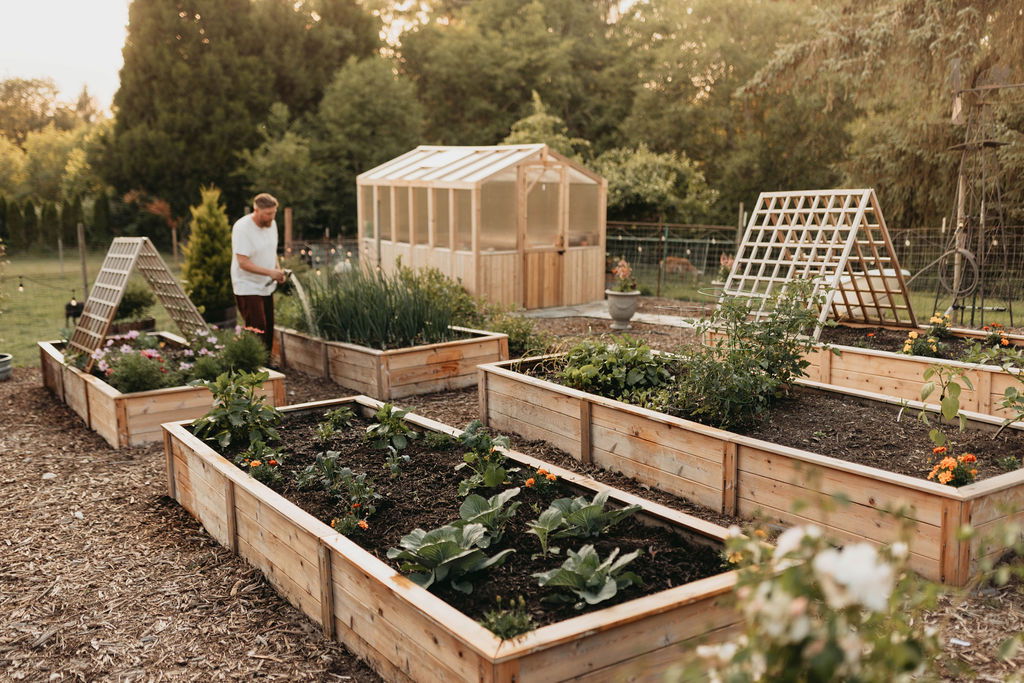
The soil in the raised beds above is being prepared for planting. Compost and fertilizer will be added to top up the beds.
If you look carefully, you can see the aluminum cross-braces on the lower bed. These will be covered with more soil.
Note the beds are built with a taper to the sides. This is because the garden is on sloping ground. For more information, read our article How to build raised beds on sloping ground.
How tall should a raised bed be? Recommended raised bed heights
Does bed height affect drainage and soil warmth?
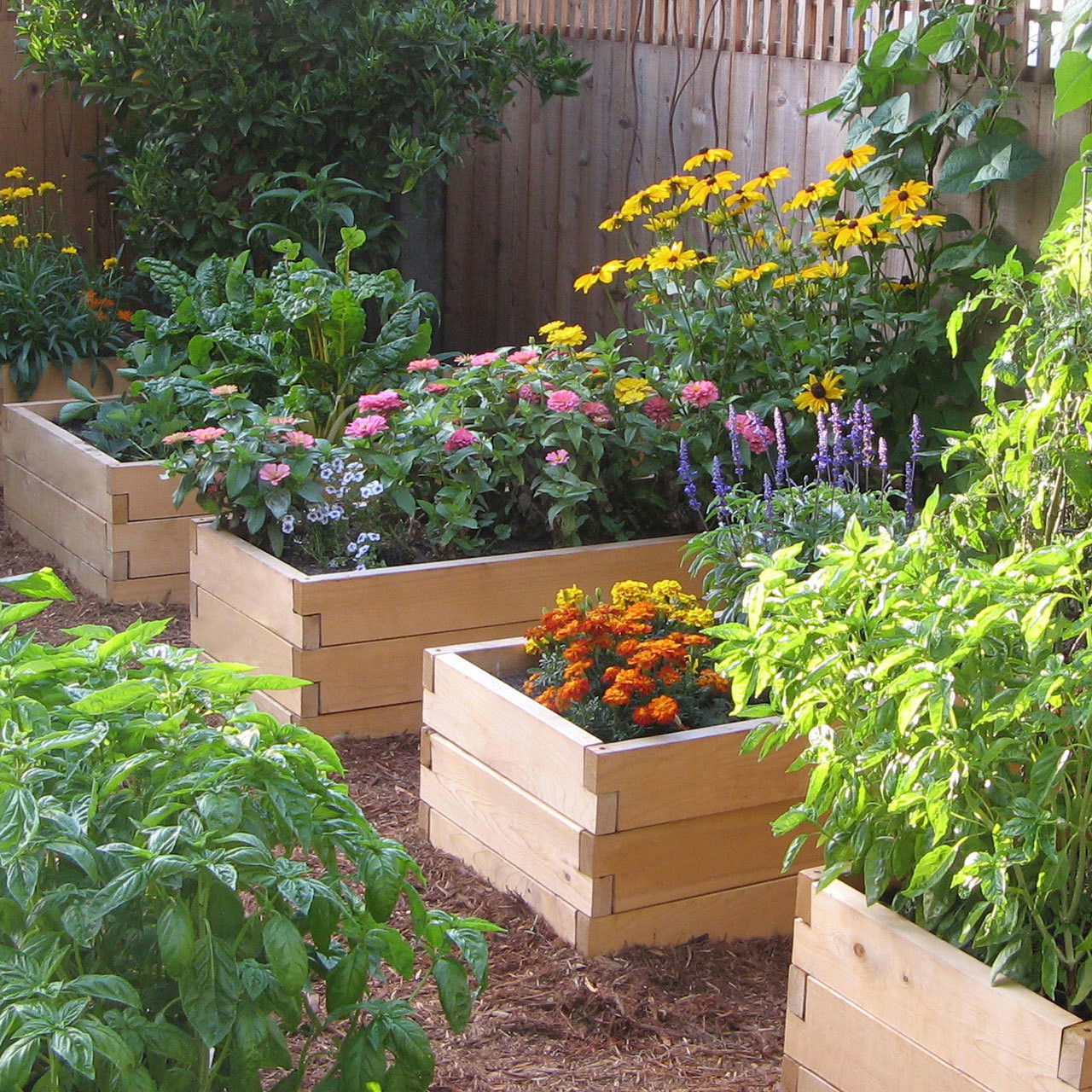
Besides the aesthetic appeal of raised beds and container gardens, they also provide good drainage for the soil within the bed. The most popular height for raised beds is 11″. (This is the height of two standard “2 x 6″ boards, which actually measure 1.5″ x 5.5”.) This height provides sufficient drainage for most crops.
For best results, there should be another 12″ or more of good soil below the bed. This gives your plants at least 18 – 20″ of soil. (The soil in raised beds is usually a few inches below the rim of the bed. This is because soil compresses after several waterings. Having the soil level down a few inches is useful because you will likely want to add a few inches of mulch.)
Callout:
Raised beds drain readily and warm up earlier in spring. This means you can set out transplants sooner and extend your growing season.
Since raised beds are well drained and the soil is above ground level, the soil within the bed warms up earlier in the spring. This enables gardeners to set out transplants sooner which helps extend the growing season.
A cold frame can be set on top of the bed during early spring to protect young seedlings and transplants from late frosts and strong winds. The cold frame can be lifted off the bed once the crops become established, and moved to another bed to help protect successive plantings.

Photo by Filip Urban on Unsplash
How much bending over do you want to do?
If you are young, fit and full of energy, then bending over or kneeling down to tend your garden may not be an issue. But if you are prone to back strain, or if you have any mobility issues, then a taller raised bed will make gardening easier.
In our family garden, the ground is sloped, and beds vary in height from 8″ – 24″. As we are ‘mature’ gardeners, we really notice the difference in working the various beds. The 24″ beds are much easier on the back when tilling the soil, setting in transplants, weeding and thinning, adding mulch and harvesting.
Container gardening in elevated planters is another option for gardeners with limited mobility. You can tend these gardens while sitting in a wheelchair. However, the same principles apply in container gardens with respect to soil depth requirements, top-dressing amendments such as compost, fertilizer and mulch. And taller plants grown in container gardens usually require staking or tying to trellis. For more information, read our article about Wheelchair Gardening Tips.
Do taller beds need cross-supports?
The taller you build your raised bed, the more volume it will hold. As the soil is watered it becomes heavier and this exerts pressure, which may cause your bed to bow outward in mid-span, near the top. If the bed is taller than 12″ and longer than 6′, it will likely require a cross-support in the center of the span, across the width of the bed, to keep the sides from bowing.
Manufacturers of raised beds often supply these supports, but if you are building your own beds, then you may want to include this feature. The cross-support can be made using wood, composite plastic or aluminum. We use aluminum 1/2″ flat stock and cut it to length with a hacksaw, then drill the ends for screws. It is a simple job, and the aluminum stock is available at most hardware stores.


Soil depth requirements for popular vegetables
When preparing a garden bed for planting, it’s helpful to know the root depth of the vegetables you want to plant. This will help determine where you may decide to plant certain crops and how deeply to prepare the soil.
For example, in our garden we may plant shallow-rooted crops like lettuce in beds where the subsoil has more clay and does not drain well. The deeper clay does not affect the shallow roots, and they benefit from the added moisture. Plants with deeper roots, such as tomatoes, would not do well in this soil depth.
NC State Extension recommends working amendments into the top 6 inches of soil as it is the primary zone for nutrient availability. This is because most root growth in vegetable gardens occurs in this relatively shallow depth.
Nutrients such as compost and fertilizers are added to the bed from above and lightly tilled in. Mulches are also ‘top-dressed’ throughout the growing season, and gradually decompose into the top layer of soil adding additional nutrients.
Taproots will travel deeper into the soil if nutrients and water are available, and this also brings more trace minerals to the plant. Larger vegetable plants will send down deeper roots. A taproot is a large, central root that grows vertically downward and serves as the dominant root of a plant. Think of it like a central anchor with smaller lateral roots branching off it.
When plants are able to send their roots deeper, they are less likely to fall over in windy conditions or if the ground becomes too wet. Large-leafed, shallow-rooted plants such as broccoli, Brussels sprouts and cauliflower will still require staking to ensure they stay upright as they grow to maturity.
Callout:
Knowing the average root depth for your garden vegetables will help you decide where to plant each crop and how deeply to prepare your soil.
Special cases: Containers, elevated planters, non-soiled beds
Some raised beds are set on cement patios or on gravel surfaces. This prevents roots from going deeper than the height of bed sides. In these cases, it is helpful to know the soil depth requirements of different vegetable crops.
Gardeners can compensate by building the raised beds higher to allow for more root space. While raised beds are commonly 8″ – 12″ tall, some raised beds have sides which are 3′ or higher. These taller beds enable deeper rooted crops to be planted even if there is no soil beneath the bed, but drainage must be provided by blocking the bed up an inch or so, or drilling drain holes near the bottom of the bed sides.
So how deep does a raised bed need to be for vegetables? And how deep must the soil be for a raised garden bed? See our soil depth for vegetables chart below.
Soil depth requirements for common garden vegetables
| Shallow Rooting 12" - 18" |
Medium Rooting 18" - 24" |
Deep Rooting 24" - 36"+ |
|---|---|---|
| Arugula | Beans, dry | Artichokes |
| Broccoli | Beans, pole | Asparagus |
| Brussel sprouts | Beans, snap | Beans, lima |
| Cabbage | Beets | Corn |
| Cauliflower | Cantaloupe | Okra |
| Celery | Carrots | Parsnips |
| Chinese cabbage | Chard | Pumpkins |
| Endive | Cucumber | Rhubarb |
| Garlic | Eggplant | Squash, winter |
| Kohlrabi, Bok choy | Kale | Sweet potatoes |
| Lettuce | Peas | Tomatoes |
| Onions, leeks, chives | Peppers | Watermelon |
| Potatoes | Rutabagas | |
| Radishes | Squash, summer | |
| Spinach | Turnips | |
| Strawberries |
Understanding root depth and soil preparation
For most vegetables, the bulk of the root mass is within the top six inches of soil. The soil should be light and well aerated to enable roots to access available nutrients. Deeper soil provides additional nutrients and trace minerals, which further facilitate plant growth. Plants will send some roots deeper if the soil conditions permit.
When preparing soil for raised beds, ‘double-digging’ the soil will aerate this deeper soil and clear it of rocks and debris.
Planting layout tips: Sun, spacing, and crop height considerations
When laying out a raised bed garden, determine the site’s north-south axis to gain the maximum benefit from sun exposure. Orienting beds north-south (with the long axis running from north to south) optimizes sun exposure from side to side across the bed, and keeps nearby plants from shading each other as the sun moves east to west during the day.
Some gardeners prefer to lay out their raised beds vertically to the sun (north to south), reasoning that this arrangement minimizes plants shading each other. This may make sense if you plan to grow a variety of crops in a single bed, and want to locate the taller plants at the rear (north) of the bed to prevent them from shading the shorter plants.
However, we find it simpler to grow only one crop per raised bed. Since the crop matures at the same time, the bed can be cleared after harvest and planted in a ‘green manure’ crop to restore nutrients in preparation for subsequent crops.
In the article "How to Construct a Raised Bed in the Garden" by A. Faust and E. Finlay (updated July 5, 2023), the authors recommend laying out beds either in a north/south or east/west direction, not on a diagonal.
Callout:
Note the height at maturity for each plant that you want to grow and organize your plantings with this in mind.
Planting height considerations
Regardless of how your garden beds are arranged, it is important to know how tall each of your planted crops will grow when mature. This is because you don’t want some of your plants blocking available sunlight.
Shorter plants like lettuce and radishes should be planted on the south side of the beds, with mid-size plants behind, and the tallest plants to the rear (north) of the planted area. Plants such as pole beans and peas, which are planted against a trellis, will block a lot of light. Locate trellises with this in mind.
Wind is another factor to consider. Taller plants are more vulnerable to wind damage, so they may need to be staked, secured to a trellis or located against a windbreak. Plants get much heavier once they begin to put out fruit, so trellises need to be well secured.
The chart below gives the approximate heights at maturity for popular vegetables. This will help determine planting location and distance between plants when planting seed or setting out transplants.
Heights at maturity for popular garden vegetables
| Vegetable | Size at Maturity |
Vegetable | Size at Maturity |
|---|---|---|---|
| Artichoke | 4' - 5' | Kohlrabi | 9" - 12" |
| Arugula | 8" - 10" | Leeks | 12" - 24" |
| Asparagus | 4' - 6' | Lettuce | 6" - 12" |
| Beans, bush | 24" - 30" | Okra | 2' - 8' |
| Beans, lima (bush) | 24" - 36" | Onions | 8" - 24" |
| Beans, pole | 8' - 12' | Parsnips | 6" - 18" |
| Beets | 4" - 12" | Peas | 2' - 6' |
| Broccoli | 18" - 24" | Peppers, hot | 12" - 48" |
| Brussel sprouts | 24" - 36" | Peppers, bell | 24" - 36" |
| Cabbage | 12" - 18" | Potatoes | 12" - 30" |
| Carrots | 6" - 15" | Pumpkin | 12" - 24" |
| Cauliflower | 12" - 30" | Radishes | 2" - 6" |
| Celery | 18" - 24" | Spinach | 6" - 15" |
| Chard | 12" - 30" | Rutabaga | 12" - 18" |
| Chinese cabbage | 12" - 24" | Spinach | 6" - 15" |
| Corn | 4' - 8' | Squash, summer | 12" - 24" |
| Cucumber | 1' - 5' | Squash, winter | 12" - 24" |
| Eggplant | 1' - 3' | Sweet potato | 12" - 30" |
| Endive | 6" - 9" | Tomatoes | 2' - 8' |
| Garlic | 12" - 24" | Turnips | 6" - 12" |
| Kale | 12" - 24" | Watermelon | 12" - 36" |

In the garden pictured above, the shortest plants (lettuce) are in the front facing north. A row of pole beans is planted behind the lettuce for late summer shade. The back row has carrots facing south, to fulfill their need for sunshine.
Considerations for soil depth and container gardening
Gardeners who lack the ground space for planting vegetables can grow in self-contained growing containers, such as planters and elevated beds. South-facing balconies and patios can provide suitable growing conditions.
Vertically grown plants like tomatoes, beans, peas and cucumbers will greatly increase the yield of your space. Also, seed companies have developed many space-saving varieties for container gardening.
The primary concern when growing in planters or containers is drainage. Of course, suitable drainage must be provided so the roots don’t rot in overly moist conditions. But moisture can drain through a planter quickly during hot dry conditions, so planters must be re-watered regularly to prevent root stress and plant wilting.
Drip-systems can be installed with timers on the hose, set to sprinkle during times you are away.
Callout:
By understanding the rooting requirements of the plants you want to grow, you’ll be more likely to provide ideal growing conditions that lead to bountiful harvests.
When choosing a planter or elevated container for growing vegetables, check to see that the bottom is constructed to allow for good drainage. Also check that the bottom is strong enough to hold the weight of the soil when it is wet. Slatted bottoms with inner permeable liners are a good choice when choosing a container for vegetable gardening.
Common questions about soil depth for raised garden beds
How deep does the soil need to be in a raised bed for vegetables to grow well?
Shallow-rooted crops typically need 12–18″, medium-rooted 18–24″, and deep-rooted crops 24–36″ of soil depth.
Do I need to prepare the ground before putting a raised bed in place?
Yes — because raised beds are open on the bottom. We recommend “double-digging” about 24″ deep before assembly to remove rocks and improve the soil for deeper root access. The deeper your raised bed, the less you’ll need to dig the ground beneath.
Why not just use a shallow raised bed if most roots are near the surface?
While many roots are in the top layer, deeper soil gives roots access to more water, nutrients and space for growth. This creates all-round healthier plants.
What is a good height for a raised bed if I don’t know what to grow yet?
A common bed height for growing a wide range of vegetables is 11″. This suits many crops, especially if there’s good soil underneath. If the soil below is poor, however, or you want to grow deep-rooted plants, a taller bed would be better.
Can I grow deep-rooted vegetables if my bed is on a patio or hard surface?
Yes, but beds on concrete or gravel limit root depth, so you’ll need to build the bed taller to give roots enough space for those crops. See the tables above.
Finding the ideal soil depth for all your raised beds
By understanding the basics of rooting behavior and the rooting depth requirements of the plants you want to grow, you’ll be more likely to provide ideal growing conditions that lead to bountiful harvests.
To buy a raised bed or planter suitable for growing vegetables, visit our online store.