








In general, wasps avoid human activity and should only be considered a nuisance when nesting near homes or high traffic areas.
Introduction
Wasps can be solitary or social, and there are even wasps that don’t sting at all. The best way to prevent unpleasant encounters with social wasps is to avoid them. If you know where they are, try not to go near their nesting places.
Wasps can become very defensive when their nest is disturbed due to their chemical communication. Wasps and bees release an alarm pheromone that marks their target and alerts the colony to attack. This can happen even when wasps are feeling threatened, not just when they sting or are injured, as some people believe. Wasps can present their stinger mid-air, releasing the alarm pheromone even from a casual swat.
Wasps are so much more aggressive than bees because they are predatory and very protective of their young. They are particularly aggressive during the last months of summer.
If you can’t avoid wasps, try repelling them using a fake nest such as the ‘Bee Free Wasp Deterrent’. These fake nests work because wasps are territorial and do not want to build a nest near another wasp’s nest. Failing that, you can use a non-toxic wasp trap, such as the Glass Wasp Trap or the Yellowjacket and Wasp Trap.
Using pesticides to control wasps (such as yellowjackets) can be effective, but these chemicals are harmful to the environment. Careless use of pesticides can also pose risks to the person applying the chemicals.
Before reaching for pesticides, see if these safer, natural non-toxic methods help control wasp problems.

Types of Wasps
Several types of wasps build paper nests that hang under eaves and from trees: the bald-faced hornet, yellowjacket, and paper wasp. All of these are social wasps, which can be aggressive and can sting you repeatedly.
Bald-faced hornets are considered somewhat beneficial because they will control many pests and yellowjackets, but because they are so aggressive, it’s not very nice to have them around. However, there are also the mud dauber and ichneumon wasps, which are solitary, almost never sting, and are beneficial predators.
The differences between bees and wasps is not always immediately apparent because they are from the same order of insects. However, honey bees are hairy and sometimes have a few other color variations like brown or orange, while wasps are smooth and shiny and always black and yellow. Wasps live in smaller colonies than bees, and unlike bees, which have workers who build the hive, the wasp queen builds the nest. Wasps also hibernate during the winter and don’t produce honey.
Beneficial Wasps
Beneficial wasps can be very effective pest control for the organic garden; they love flowers and contribute to pollination, though not as much as honeybees. The following types of wasps can be quite beneficial for controlling predators:
- Braconids: small wasps that can control caterpillars and grubs
- Ichneumonids and pteromalids: control caterpillars and beetle larvae
- Tiphiids/scoliids: control Japanese beetles and June bugs
- Eulopids: can control Colorado potato beetle

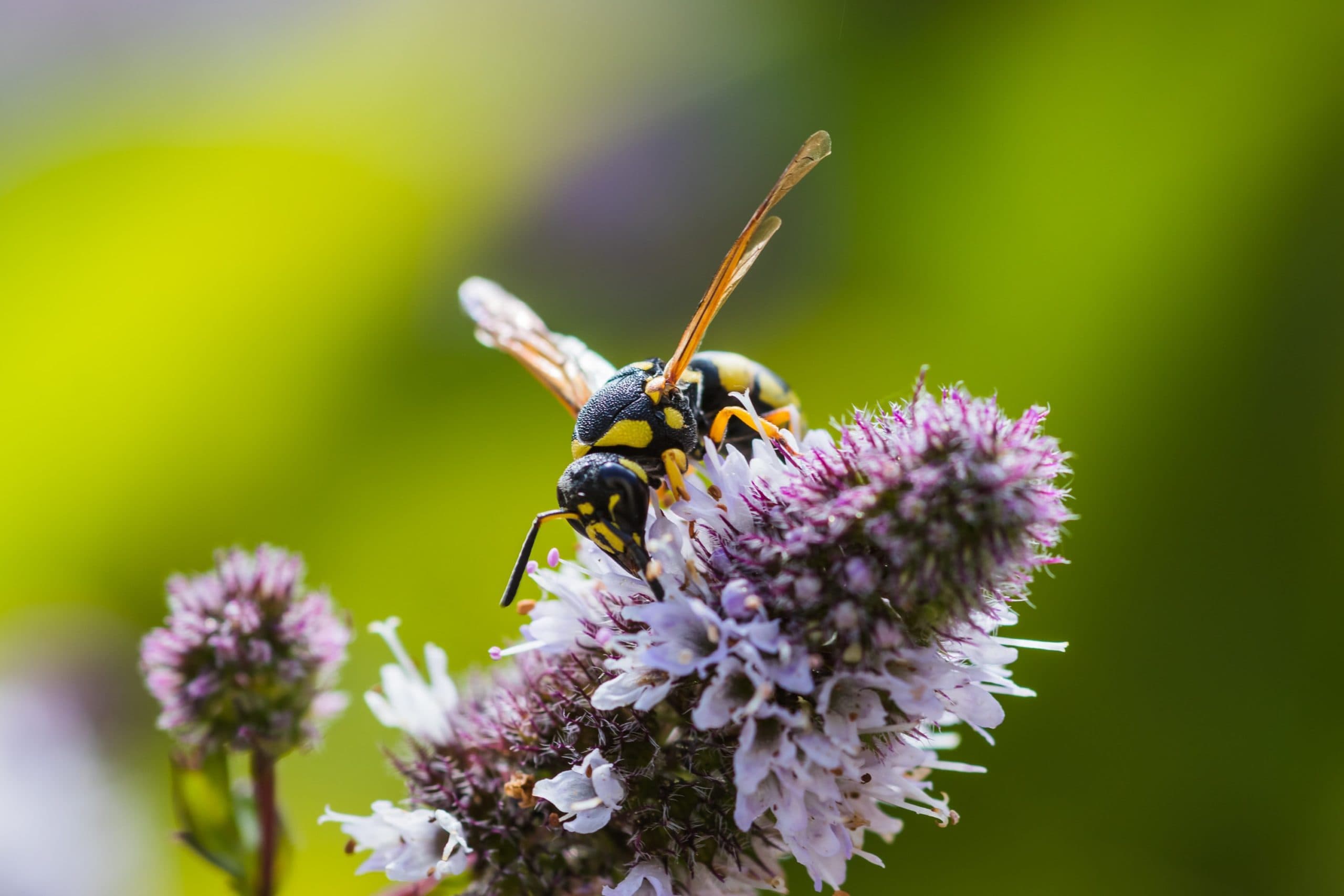
Photo by Ardi Evans on Unsplash
Prevention
Preventing wasps from nesting around your home is your first line of defense against unpleasant wasp encounters.
Seal Entry Points
Solitary wasps in the home can be a nuisance; daily sightings of wasps in the home may indicate inside nest building, and more attention to the problem is required. Searching for and sealing off their point of entry is the best line of defense. Check your house for unsealed vents, torn screens, cracks around windows and door frames, and open dampers. Observe the flight path of a wasp, especially in the morning, which may reveal the entry/exit point.
Remove Food Sources
In spring and early summer, wasps are attracted to protein foods. Any food left outdoors, such as pet food, picnic scraps, open garbage containers, or uncovered compost piles should be removed or covered. Wasps imprint food sources and will continue to search an area for some time after the food has been removed.
In late summer and early fall, wasps turn their attention to sweet foods. Their behavior is also more aggressive. Open cans of pop, fruit juice, fallen apples beneath fruit trees, and other sweet food sources will attract wasps. Be sure to cover drinks and open food containers, keep a lid on the compost, and avoid walking barefoot near fruit trees. Remove any fallen fruit rotting on the ground.
Avoid Swatting
Swatting and squashing wasps is counterproductive. When a wasp is squashed, a chemical (pheromone) is released which attracts and incites other nearby wasps. It’s best to walk away from a hovering wasp.
Watch What You Wear
Avoid wearing bright colours or floral patterns. If you look like a big flower, you may be attracting the curious wasp looking for nectar.
Avoid Perfumes
In the later part of the summer, wasps are attracted to sweet smells. Minimize use of perfumes and other strong scents.
Wasps Building Nests in Your Birdhouse?
Minimize this common problem by lining the under-roof area with aluminum foil. Use a staple gun to attach. Another option is to rub the under-roof area liberally with bar soap; ordinary soap like Ivory soap will do. One application can last through an annual wasp season.
Use a Fake Nest
Products like the Bee Free Wasp Deterrent will trick territorial wasps into believing that other wasps already live in the area. Most predatory wasps will avoid building a nest within a few hundred feet of another nest.
Use Herbs
Wasps don’t like herbs that are very aromatic, especially spearmint, thyme, citronella, and eucalyptus. Plant some of these around your patio and outdoor sitting areas to repel wasps.

Photo by soufiane koraichi on Unsplash
Wasp Traps
There are varying opinions on the effectiveness of using traps to reduce the wasp population in specific areas. This is partly due to the distance wasps will travel when foraging. Wasps have been known to fly from 300 to 1000 yards (275 to 915 meters) from their nest in search of food. Traps are more likely to be useful in small areas.
Setting out traps in the early spring, when only a few wasps may be evident, is most effective. This is because these early season wasps are usually queens, and it’s estimated that each trapped queen represents several thousand worker wasps in the late summer. You can buy wasp traps or make your own.
Make a Simple Homemade Water Trap
Use a razor knife to cut the top from a two-liter plastic pop bottle. Cut just above the shoulder of the bottle. Discard the screw top. Fill with water about halfway. Coat the neck with jam, invert it and set back on the bottle. Use two small pieces
of tape to hold it in place.
Wasps will go down the funnel to get the jam, but will find it difficult to get out. Most will drop into the water and drown. A few drops of dish soap in the water will make it hard for the wasps to tread water, and will hasten their demise. (You can also add a 1/4 cup of vinegar to the water to discourage honeybees from entering the trap in search of water.) The trap will be most effective if set about 4′ above ground.
Note: In the spring and early summer, wasps are attracted to protein-based baits; use jam or other sweet baits in later summer and into fall.
Empty the Trap Daily!
As more wasps are caught, they create a raft on which other wasps can survive for a considerable time. Some of these wasps then find purchase on the plastic of the bottle and eventually crawl out. The longer the trap is untended, the more wasps will manage to escape, which may result in swarming. Empty the trap daily and discard contents some distance away from the spot where the trap is located.
Buy a Nontoxic Wasp/Yellow Jacket Trap or a Wasp Repellent

Glass Wasp Trap
This sturdy, colored glass trap will take a bite out of your wasp problem. Simply add the included lure, a bit of water, and replace the stopper. Hang or place in an area with high wasp concentrations. Wasps fly up through the bottom hole, become trapped, and drown in the water. After two weeks replace the lure, or just add sweet liquid (lemonade works).
Click for more info, or to buy the Glass Wasp Trap

The Bee Free Wasp Deterrent - Keeps Wasps Away
The Bee Free Wasp Deterrent repels wasps, it does not harm or kill them. It works on a very simple principle: wasps avoid the nests of other wasps. By giving the appearance of a real wasp nest, any nearby wasps will keep their distance, commonly about 20′ or further. No chemicals, folds flat to bring on picnics, environmentally safe. Think of the Bee Free as a “scarecrow for wasps”.
Click for more info, or to buy the Bee Free Wasp Deterrent

Yellowjacket and Wasp Trap
The Oak Stump Farms Yellowjacket Trap safely and efficiently catches yellowjackets and other wasps by baiting and capturing them in a reusable plastic jar. This trap is very effective because the lure’s dual action is irresistible to nearby wasps. A translucent cover over the jar hides dead wasps from view.
Click for more info, or to buy the Yellowjacket and Wasp Trap
Homemade Wasp Control
There are many recommendations for homemade wasp repellent, most of which include dish soap. However, because wasps can be aggressive, an attack from a wasp swarm is potentially fatal. For this reason, never spray anything on wasps directly.
Instead, consider using these on surfaces around your home:
- Peppermint oil: Mix equal parts peppermint essential oil and water, and apply a small amount to hair, arms, ankles, socks, etc. Or add a bit of dish soap as a spray repellant.
- Chilli peppers: Boil two cups of chopped chili peppers in two cups of water for two minutes. Allow the mixture to cool and use as a spray repellent on surfaces.
- Essential oil blend: Add a few drops each of peppermint oil, clove oil, geranium, lemongrass oil, and a few squirts of dish soap. Spray on surfaces.

How to Destroy a Wasp’s Nest
Wasps are part of nature’s design and their nests, as a general rule, should be left undisturbed. Wasps are usually non-aggressive and don’t pose a serious threat to humans. However, if a wasp nest is located too close to the home or in a location that is in conflict with human activity, then you may need to remove the nest.
If you know wasps are nesting nearby but can’t find their location, you may be able to locate the nest by observing the flight patterns of the wasps: if they are flying in a straight line, they’re likely on a flight path to or from the nest. Wasps flying directly in and out of a single location may be entering and leaving their nest.
Before approaching the nest, be sure to wear protective clothing that covers the whole body, including gloves and a veil that covers your face, ears, and neck. Wear several layers of shirts and pants. Tape clothing cuffs at wrists and ankles close to your body. Check carefully to ensure there are no exposed parts of the body; wasps may target even the smallest exposed areas.
Wait until well after dark before removing the nest. Wasps are drowsy and slower to react during the night, but you should still exercise caution during the nest removal process. Use a headlamp if you have one; otherwise have a helper to hold a flashlight for you. You’ll need both hands free. Filter the flashlight by wrapping the lens with red cellophane or thin red cloth, as wasps are attracted by yellow light. A headlamp with a red light setting is even better. Step lightly and try not to talk when approaching the nest; wasps are sensitive to vibrations.
Aerial Nests
Place a cloth bag over the entire nest and quickly tie it off at the top; as you draw in the tie, pull the nest free. The bag should be well sealed. Set the bag in a pail of water; drop a rock on the bag to keep it fully submerged.
Ground Nests
If the entrance to the nest is easy to see, it can be blocked using a large, clear bowl. Use caution as there may be more than one entrance to underground nests. Set the bowl over the nest entrance and work it into the ground a bit so there are no exit routes for the wasps. This will confuse the wasps, but they won’t try to dig a new entrance. The bowl should remain in place for several weeks.
Underground or Inside Wall Nests
Nests in wall voids or underground are more difficult to remove, and should be left to the professional. (If you detect a wasp nest in the wall, do not try to eradicate it from the outside. This will force them further into the house.) When hiring a professional to treat wasp problems in the home, ask what methods will be used. A non-toxic alternative to insect sprays and dusts is vacuuming. Some professional exterminators are equipped with specially adapted vacuum cleaners to draw out the wasps, which are then sold to pharmaceutical companies who extract the venom for immunotherapy.
Never try to burn an active wasp nest or flood a nest with water, since this will likely make the wasps angry and aggressive.
After Removing the Nest
After you remove a wasp nest, you’ll want to make sure that new nests don’t appear in the same location. Seal cracks and holes with spray foam, place your traps, and hang fake wasp nests in areas where you want to deter new nest builders. You can also treat these areas with the DIY repellents listed above. In most cases, newly mated wasp queens are the only ones to survive the winter—and they hibernate outside the nest in burrows or other protected locations. Most wasps will not recolonize old nests, so once a nest is dormant or empty, there is no need to remove it.
The exception is German yellowjackets, which have been known to live in the same nest for multiple years. In North America, the German yellowjacket nests predominantly in building cavities where nests have been known to reach 14 feet long. Removing the nests of German yellowjackets is a job best left to professionals.

Photo by Wolfgang Hasselmann on Unsplash
If You're Stung
If stung, the wound should be washed with water which helps remove some of the venom, and treated with an anti-sting product or antihistamine cream which can reduce the pain and spread of the venom.
Another treatment is to apply a poultice of meat tenderizer (for people not allergic to bee stings) or salt to the sting site as soon as possible after the incident. Use about 1/2 teaspoon mixed with enough water to produce a paste. Leave on the sting site for about 30 minutes.
A site visitor from Waukesha, Wisconsin offers this suggestion for sting treatment:
“Soak a tissue or cotton swab with distilled white vinegar and apply to site of bite. This will relieve the stinging in a few seconds. Continue applying this to the bite site until the victim finds the bite no longer is stinging. I have used this many times on myself as well as the young and old.”
A visitor from Ottawa suggests:
“Take a bunch of wild plantain –which grows prolifically on most lawns—for immediate relief. Chew it up and press it onto sting. For a more elaborate poultice, add 1/4 teaspoon salt, 1/4 tablespoon of vinegar, 1/4 teaspoon of baking soda to chewed plantain in a mortar. Mix well and apply. It works like a charm … “
Brad from Orlando suggests this simple, natural remedy:
“Make a paste from water and baking soda on a soft cloth or tissue; apply it firmly to the sting and leave it on for 30 minutes to an hour. It will stop the stinging and itching and draw the venom out. You will see a yellow spot of venom in the soda when you remove the patch. This works for wasp, yellowjacket, and non-poisonous scorpion stings.”
Serena from Maryland has this simple remedy:
“A wasp sting is also relieved by cutting an onion in half and rubbing the cut part on the sting site.”
Scott from Florida has this suggestion for deterring wasps from building nests in the eaves under your roof:
“Down here in South Florida, we paint our house overhang with sky blue color paint. The paper wasps and the mud daubers will not build a nest on the blue paint. You can paint your birdhouses underneath blue too!”
Wasp Allergies
If the sting is in the throat or mouth, or if an allergic reaction occurs, seek medical attention immediately. Symptoms of allergic reactions may include difficulty in breathing, dizziness and nausea. One symptom which should alert people that they may be having a reaction is feeling very tired. If you are stung and you want to go to sleep, get help! Anyone with a history of hypersensitive reactions should have a sting emergency kit available. High-risk persons should wear a medical alert bracelet or other alert item.
Use of topical antihistamines (as opposed to oral antihistamines) may occasionally lead to skin sensitization (a form of allergy). It is safer to use topical steroids instead, which are just as effective at combating the stinging sensation and itch felt with wasp stings. Additionally though, steroid creams also help fight inflammation and the “tight” feeling from stings.
Allergies to wasps stings are obviously more of a problem. They can occur even if you have never reacted to previous stings. Importantly, adrenaline is required to reverse the potentially life threatening effects of swelling of the throat and constriction of the airways. If you do not have adrenaline with you, it’s best to create your own through physical exertion. Do not lie down and rest because this may result in permanent rest!
A site visitor from Chicago offers this suggestion:
“If you are stung and have an allergic reaction, and you have no antihistamine, a teaspoonful of instant coffee under your tongue will work effectively as a temporary antihistamine, and allow you more time to get medical help.”
This is a valid suggestion, but it is vital that it is NOT decaffeinated, since it’s the caffeine that can support a dropping blood pressure pending medical treatment. That teaspoon may be repeated in 10 minutes.
Infections From Wasp Stings
Generally if a wasp sting remains hot and inflamed after 8 – 12 hours with no sign of improvement, it’s best to seek medical advice about getting antibiotic treatment.
The other problem with wasp stings is that in many cases, they are heavily infested with bacteria picked up by the wasp from faecal matter during hunting. Because the bacteria come from faeces, they can cause quite nasty infections and early treatment is recommended with antibiotics to prevent sepsis.
If a sting does become infected, it’s best to stop the topical steroid and take oral antihistamines. Unfortunately, the sedating antihistamines are the ones that work best so driving might then become a problem.