





A few simple steps taken now will give your fruit trees a head start.
Harvesting fruit from your own trees is a most satisfying activity, but care must be taken to ensure the fruit will last when stored through the winter months. Proper storage of winter keeper varieties of apples can provide you with apples through winter and into early spring.
Fall is also the time to look after the health of the tree. Caring for fruit trees with a few simple practices will help the tree through the winter dormant period and ensure its vitality for spring flowering and fruiting.
Suggestions for preparing your orchard for winter
1. Make sure that your tree is watered well into mid-October
Your tree needs to go into the winter with a good moisture supply. To know that you have watered sufficiently, place a pan or dish under the tree and water until the container accumulates 5-8 cm (2-3 in.) of water. This amount will water the trees deeply down into the root zone, whereas less water will only dampen the soil close to the surface. If planting fruit trees in fall, choose bare root varieties well adapted for your area.
2. Rake fallen leaves from under fruit trees
Place raked leaves in areas away from healthy fruit trees. This prevents leaf-borne diseases from recurring. It also reduces habitat for mice, which can be destructive to fruit trees. Cutting the grass around the base of the tree has a similar benefit.
3. Don’t fertilize your trees
Under most circumstances, most fruit trees in healthy soils do not require fertilizer in the fall. Do not apply fertilizer after July 1. Never fertilize young trees. If fertilized, they will take longer to mature and bear fruit. If fertilized in the fall, young trees in particular will lack winter hardiness because they will continue to grow. Fertilize your fruit trees only if they shows pale leaves and weak growth. If these signs occur, and you’re wondering what to feed apple trees, a small amount (1 cup) of a balanced fertilizer (e.g., 16-20-0) for a larger tree will usually help it along. Use less for a smaller tree.
4. Pick fruit carefully
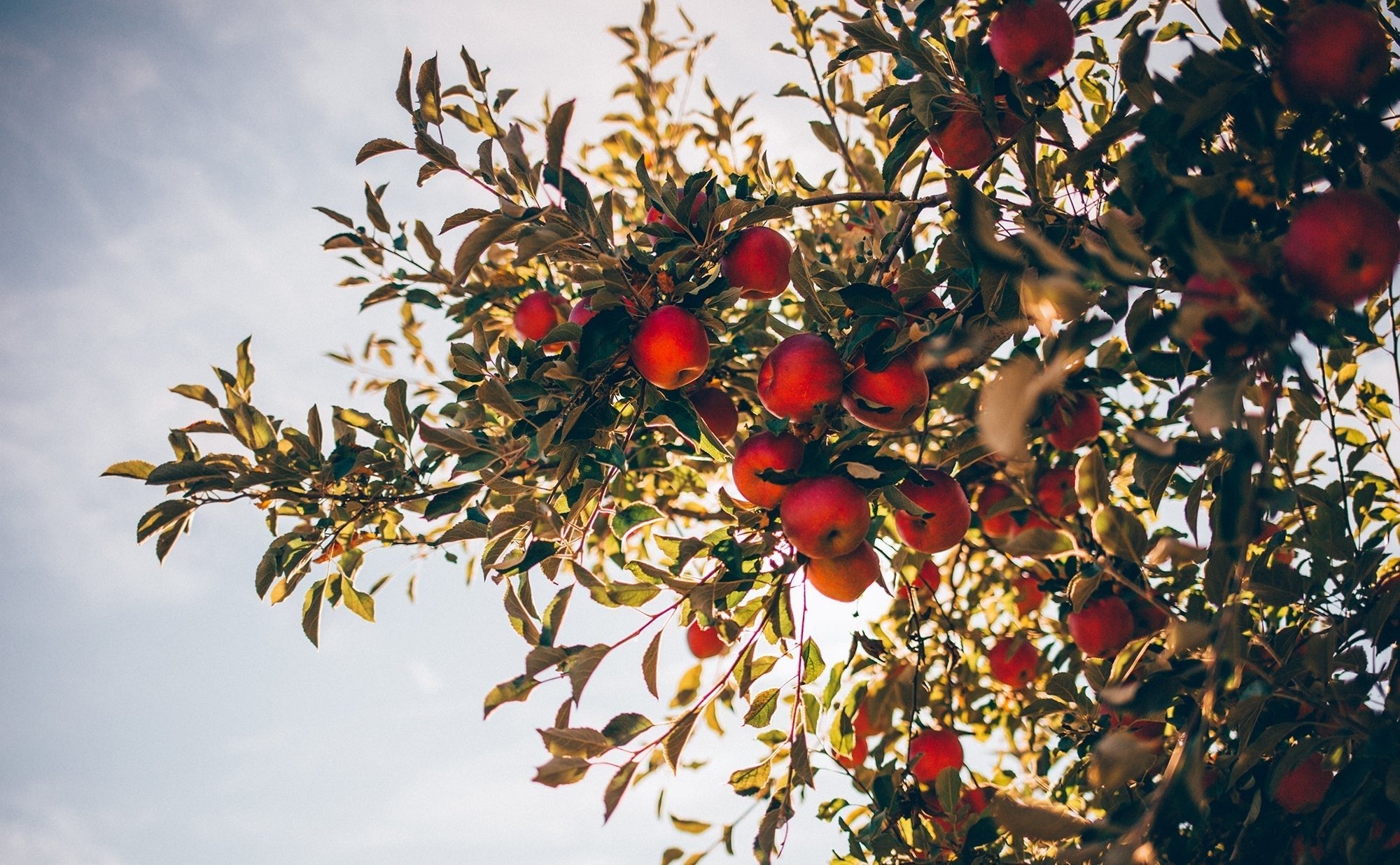
The stem should remain on a picked apple, but if the leaf spurs are breaking off with the stem, it’s likely that you’re picking too soon, or your picking technique isn’t working. Try grasping the apple from the bottom and gently lifting it upwards till it is upside down; the twig usually breaks free easily. Another technique is to twist the fruit upwards and to one side.
5. Separate flawed fruit from perfect fruit when storing
Even the smallest nick or beak mark on the fruit will encourage spoilage. Flawed fruit should be set aside for fall eating and cooking; save only the perfect fruit for winter storage.
6. Wait until early spring for all major pruning
Only minor pruning should be done in other seasons.Pruning in the late summer or fall may encourage the tree to continue growing. It must stop growing for some time in order to harden-off before winter. If it does not have this hardening-off period, it will not become come fully winter hardy, and winter injury may occur.
7. Control Insects
Did you have canker worms on your trees last spring? If you did, fall is the time to get some tanglefoot on the tree to prevent female moths from going to the top of the tree, where they lay the eggs that hatch into next year’s worms. Did you have tent caterpillars on your tree last spring? Watch for their egg bands on the twigs in the fall. Remove any bands, and you will have few or no problems next spring.

8. Don’t leave your fruit on the tree too long before picking
Overripe fruit attracts pests such as wasps and racoons, and is prone to rot. Overripe fruit also puts a burden on the tree structure and may result in broken branches. Also, overripe fruit will not last as long in storage.
Pick pears before mature and allow them to ripen in the house at cool room temperature. Cut into a pear and check the seed colour. Pick pears at the first hint of browning of the seeds. Apples can be picked when each seed is about half brown. Once picked, they can be stored at room temperature for a few days and then used. If you want to store your apples for a longer period, pick them when you notice the first hint of brown in the seeds. Place newly picked apples for storage in the refrigerator and reduce wilting by placing them in a perforated plastic bag.
Plums are tricky, and often fall from the tree just before they are ripe. They should be picked when they are a little on the green side and allowed to ripen at cool room temperatures.
9. Protect branch spurs
Branch spurs are the short twigs holding the fruit, and they are easily damaged when harvesting fruit from the tree. Use a pole picker rather than climbing through the tree when picking fruit, as the spurs break off easily when you brush against them while in the tree. The fruit for subsequent years is produced on these spurs.
10. In cold climates, protect trees from sunscald
Sunscald can occur in late winter while the roots are still frozen. Sun can warm the bark during the day, but cells die at night causing damage to the tree. Young trees with smooth bark are particularly susceptible to sun scald. Plastic tree guards or paper tree wraps can be placed around the lower trunk to prevent sunscald; other methods include painting the lower trunk with white latex paint, or wrapping aluminum foil to shade the trunk.
11. Protect trees from mice and rabbit damage
In cold climates, mice and rabbits can damage or destroy fruit trees by eating the lower bark. Observe the lower bark for mice activity, and install tree guards if this is a problem in your orchard.
12. Compost or juice windfalls and damaged fruit
Windfalls and slightly damaged fruit can be saved for eating or processing. However, some fallen fruit will be too damaged to save. This fruit attracts wasps and other pests, and is better off in the compost where it can contribute to building healthy compost for spring. Wear gloves when picking fruit off the ground, as wasps can be present in the hollowed-out parts of fallen fruit, and pose a hazard.
Windfalls are also among the tastiest apples for summer/fall eating. This is because they have reached the peak of ripeness. They often have a bruise, sometimes difficult to see, which is why they should not be stored with the ‘perfects’. Remember the old saying “One bad apple spoils the whole bunch.” This is so true. For this reason we gather windfalls and use them for making our own homemade apple juice. Making juice is a perfect way of using apples which are not perfect enough for storing, or for using the excess “early-eating” apples such as Transparents and Gravensteins which are not meant for storing.

13. Check tree stakes for firmness and vertical orientation
If you have any of your trees staked, now is the time to check to see if they are still well set and vertical. During the summer months of growth and taking on weight due to the fruit load, the stakes can loosen in the ground, allowing the tree to lean. In our orchard, the trees which became ‘leaners’ have all since fallen during winter wind storms. We now take care to see that the stakes on young trees are sound, and each fall we cinch-in the ropes (from stake to tree) enough to keep the tree as vertical as possible.
14. Support dwarf trees permanently
Dwarf trees should be permanently supported (preferably with three stakes spaced out around the tree) because they have small root systems and can be tipped by high winds, especially in fall while leaves and fruit are still on the tree. Since these are permanent stakes, they should be made of metal, not wood. Thread the guy wires from each stake through a length old hose cut long enough to protect the trunk from the wire looping around it.
15. Repair fences
While you’re at it, take a careful look at the fence around your garden or orchard. If deer get in they may nibble the bark around the base of young trees which will harm of kill the tree. Make sure your fence has no weak spots that will give in to winter storms.

Eco Wood Treatment
Non-toxic wood preservative that penetrates deep into wood fibers to protect against rot and moisture while creating a natural silver-grey weathered look. One-time application, low maintenance, eco-friendly.
Over the years, we’ve come to realize that the fruit from our orchard yields the greatest ‘return on effort’ of all our garden crops. Now that the price of organic apples has risen to as much as $1 per apple, we see real value in a mature fruit tree which may have 500 – 1000 apples! Considering this value, and the relatively small amount of work it takes to realize, it’s well worth taking the time to conduct fruit tree maintenance during and after the harvest to ensure future productivity.
For year round tips, see our fruit tree care guide. Thank you for reading about fall care for fruit trees!
Frequently asked questions
When to fertilize apple trees?
The best time to fertilize apple trees is in springtime. Apple tree care in fall is simple and involves picking fruit, raking fallen leaves, and re-establishing any branch supports before the snow flies.
How to care for apple trees?
In autumn, follow the suggestions above for all common fruit trees. Apple trees may need specialized care in the dormant season to prevent pests and diseases from taking hold. See our fruit tree guide for more information on how to care for fruit trees, including apple varieties.
What is the best advice for fruit tree care?
Maintain cleanliness around the base of the tree, cleaning up leaves that fall in the autumn. These may harbor pests that overwinter and emerge in the spring, ready to do damage.
 Responses (31)